7 min read
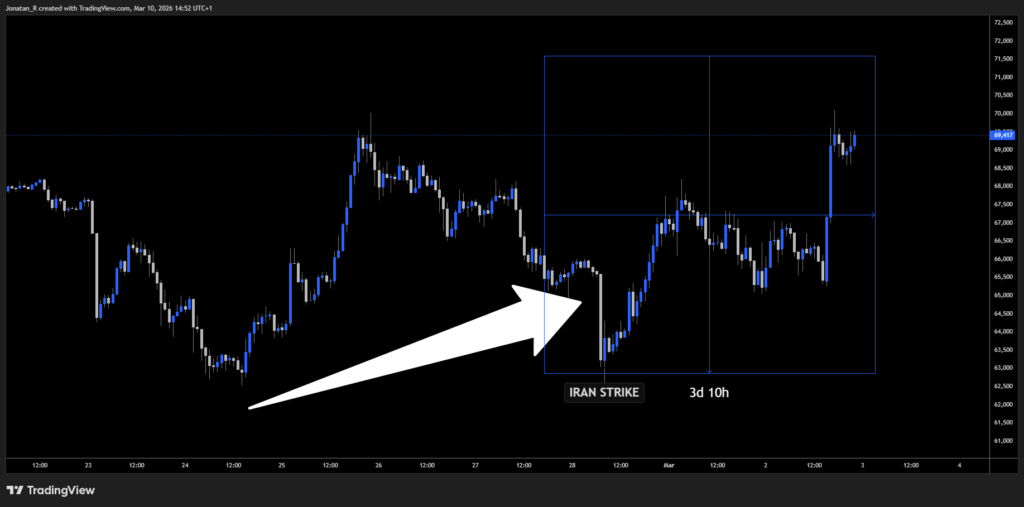
If you traded Bitcoin (BTC) on the weekend of 28 February 2026, you already know what happened. US and Israeli forces struck Iran, BTC dropped from roughly $65,500 to $63,000 within hours, and roughly $300 million in leveraged positions were liquidated in the initial sell-off, before most of the world had processed the headlines.
Then Monday came. Gold surged toward $5,400. Oil spiked as much as 13%. The Nikkei fell. The S&P 500 futures pointed sharply lower before recovering.
Crypto traders saw it all coming, because they were already trading it.
This is one of the most underappreciated edges in crypto: BTC trades 24/7, and when a major geopolitical event hits outside traditional market hours, it becomes the only large, liquid asset available to trade. That weekend price action isn’t noise. It’s a real-time sentiment reading that often previews what traditional markets will do when they open.
Why BTC reacts first
Traditional markets for gold (XAU/USD), Foreign exchange (Forex) pairs, and equity indices close on weekends. When a geopolitical shock hits on a Saturday, there’s nowhere to express risk-off sentiment except crypto.
This is exactly what played out during the Iran strikes:
- Saturday 28 February: BTC dropped roughly 4% as traders sold the only liquid asset available. The move reflected broad risk-off sentiment, not a crypto-specific event.
- Sunday 1 March: BTC recovered to roughly $68,000 after Iran confirmed the death of its supreme leader, suggesting markets were pricing in a potentially shorter conflict.
- Monday 2 March: Traditional markets opened and confirmed the signal. Gold tested $5,400. Oil jumped as much as 13%. The Nikkei dropped 1.35%. The US dollar index (DXY) rose to its highest level in over a month.
The pattern is clear: BTC moved first, and traditional markets followed the same risk-off direction on Monday.
What crypto traders can learn from the Monday open
The BTC weekend move gave a useful preview, but each traditional market reacted differently to the same event. Understanding these differences is what turns a single geopolitical headline into multiple potential setups.
Here’s how the Iran strikes played out across asset classes on Monday 2 March:
- Gold (XAU/USD) surged nearly 2% toward $5,400 as investors moved into safe-haven assets
- Oil (Brent crude) spiked as much as 13% on fears of supply disruption through the Strait of Hormuz
- Equity indices initially sold off, with Nikkei 225 (listed as JAPAN on the PrimeXBT platform) down 1.35% and the European Stoxx 600 falling 1.61%, before US indices partially recovered
- The US dollar strengthened roughly 1%, with the DXY rising to its highest level in over a month as capital flowed into dollar safety
- BTC held its weekend recovery around $66,500-$68,600 and actually outperformed equity futures on the day
The same event. Five different reactions. Five different potential setups.
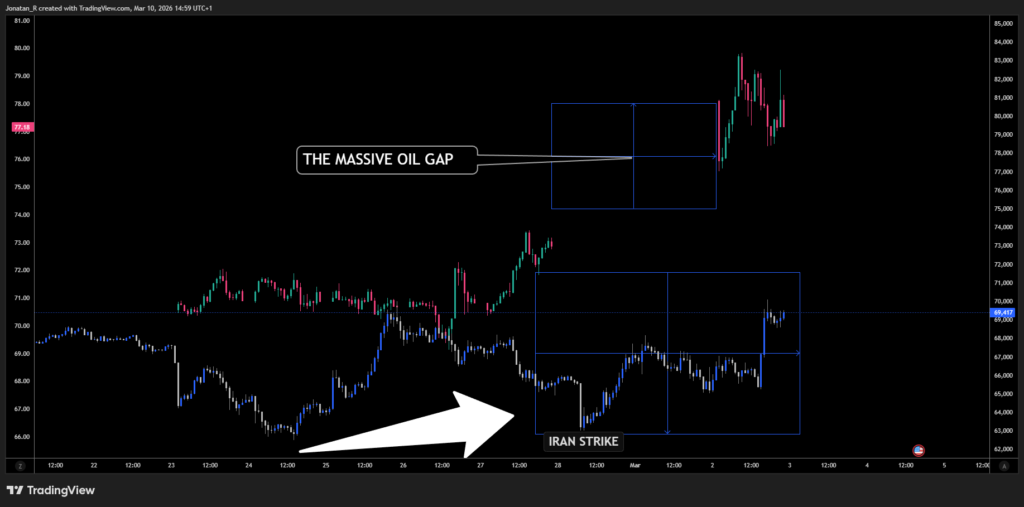
The chart below shows this in action. BTC (bottom) dropped on Saturday as the only market open to absorb the shock. Oil (top) couldn’t react until Monday, when it gapped sharply higher on supply disruption fears. That gap is the opportunity a crypto-only trader would have seen coming but couldn’t act on without multi-asset access.
A framework for any geopolitical shock
The Iran conflict is a specific example, but the pattern repeats. Whether it’s a military escalation, a surprise sanctions announcement, or a major political crisis, the sequence tends to follow a similar structure:
1. The weekend shock
A major event breaks while traditional markets are closed. BTC reacts because it’s the only large market open. Watch for the direction, the speed, and the size of the move. A sharp, high-volume drop on BTC may suggest that Monday’s traditional market open could see broad risk-off positioning.
2. The Monday open
Traditional markets catch up. Gold and the US dollar tend to benefit from safe-haven flows. Oil may spike if the event involves energy-producing regions. Equity indices often gap lower on the open but can recover quickly if the market believes the disruption will be short-lived.
3. The divergence
This is where it gets interesting for multi-asset traders. After the initial reaction, different markets start to diverge based on the specific nature of the event. During the Iran strikes, gold held its gains, oil stayed elevated due to the Strait of Hormuz risk, but equities started recovering within hours as Wall Street priced in a short conflict. BTC, meanwhile, continued trading in its existing range.
Traders who only watch crypto missed the gold and oil moves entirely.
What this means in practice
On the PrimeXBT platform, you can trade BTC/USD, XAU/USD, oil, Forex pairs, and equity indices from a single account. That means when a geopolitical event hits over the weekend, you can:
- Read BTC’s reaction as a real-time sentiment gauge
- Prepare for Monday by identifying which traditional markets are most likely to be affected
- Act across multiple instruments rather than being limited to crypto while other markets offer potentially cleaner setups
The goal isn’t to predict geopolitical events. It’s to recognise that when they happen, your 24/7 access to crypto gives you an information edge, and multi-asset access lets you act on it.
Trading involves risk.
Author


 Risk Disclaimer
The content provided here is for informational purposes only. It is not intended as personal investment advice and does not constitute a solicitation or invitation to engage in any financial transactions, investments, or related activities. Past performance is not a reliable indicator of future results.
The financial products offered by the Company are complex and come with a high risk of losing money rapidly due to leverage. These products may not be suitable for all investors. Before engaging, you should consider whether you understand how these leveraged products work and whether you can afford the high risk of losing your money.
The Company does not accept clients from the Restricted Jurisdictions as indicated in our website/ T&C. Some services or products may not be available in your jurisdiction.
The applicable legal entity and its respective products and services depend on the client’s country of residence and the entity with which the client has established a contractual relationship during registration.