6 min read
Most crypto traders watch Bitcoin (BTC) charts, exchange order books, and on-chain data when looking for their next move. Fewer look at the Foreign exchange (Forex) market, and that’s potentially a missed opportunity.
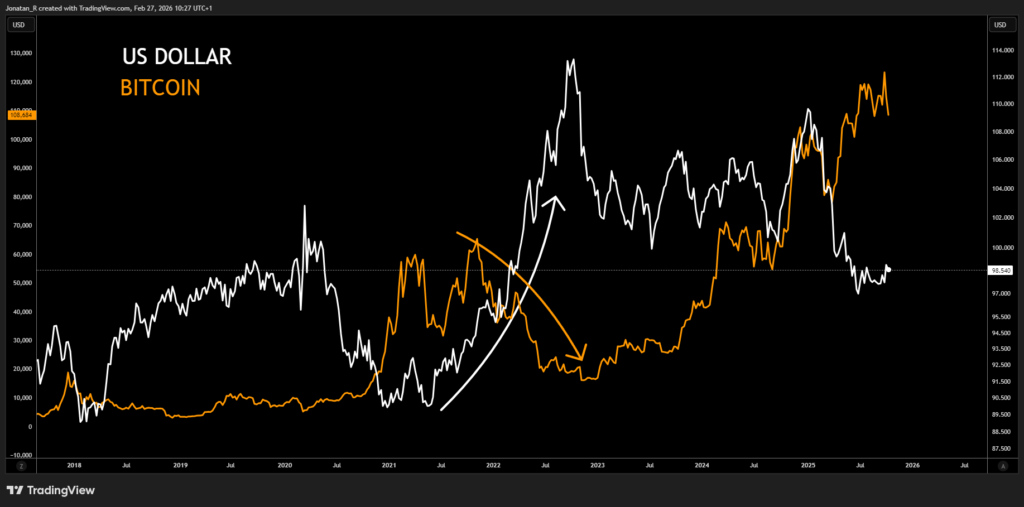
The US Dollar Index (DXY), which measures the dollar’s strength against a basket of major currencies, has shown a notable inverse relationship with BTC over multiple market cycles. When the dollar weakens, BTC has historically tended to strengthen, and vice versa. Understanding this relationship on a chart level can give crypto traders an additional lens for timing entries and exits.
The DXY and BTC relationship on the chart
The connection between DXY and BTC isn’t theoretical. It’s visible on a price chart.
Pull up a DXY daily chart alongside BTC/USD on the same timeframe. In many periods, you’ll notice that:
- Major DXY tops have coincided with BTC bottoms
- DXY breakdowns have preceded or accompanied BTC rallies
- The correlation isn’t perfect, but it tends to reassert itself during macro-driven phases
The reason is structural. When the US dollar weakens, global liquidity conditions tend to ease. Capital flows into risk assets, including crypto. When the dollar strengthens, liquidity tightens, and risk assets tend to face headwinds.
For a technical trader, you don’t need to fully understand the macro mechanics. What matters is that DXY chart patterns, particularly breakouts and breakdowns at key support and resistance levels, can provide early signals for directional moves in BTC.
Technical analysis on DXY
If you can read a BTC/USD chart, you can read a DXY chart. The same technical analysis (TA) tools you already use transfer directly.
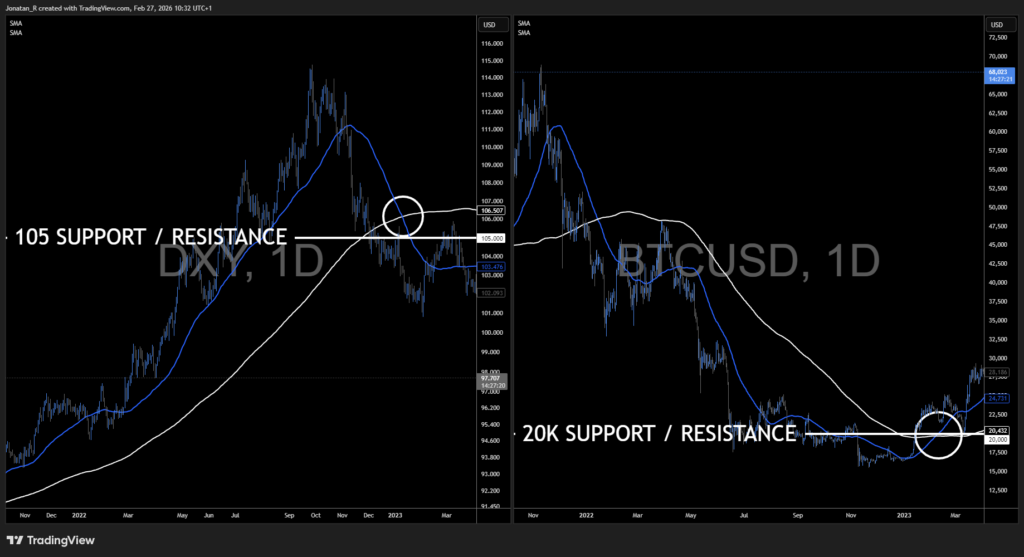
Trend direction is the starting point. Apply a 50-day and 200-day moving average to DXY the same way you would on BTC. When DXY is trading below both, the broader environment tends to favour risk assets. When it’s above both, dollar strength may act as a headwind. A golden cross or death cross on DXY can signal a shift in the macro backdrop, just as it does on a crypto chart.
Horizontal support and resistance levels tend to hold well on DXY, particularly around psychological round numbers. These levels act as magnets for price action, just like $50,000 or $100,000 on BTC. When DXY tests a major horizontal level, it’s worth checking your BTC chart for a potential setup in the opposite direction.
Fibonacci retracements on DXY’s larger moves can also help identify zones where the dollar might stall or reverse. If DXY pulls back to a key Fibonacci level within a larger trend and holds, the trend may continue. If it breaks through, it could signal a reversal that ripples into other markets.
The core idea: whatever TA framework you use on BTC/USD, apply it to DXY as well. If DXY is showing a breakdown on the chart, that’s a potential tailwind for crypto. If it’s showing strength, that’s context worth having before entering a BTC position.
When the correlation breaks
It’s important to recognise that the DXY/BTC inverse relationship is a tendency, not a rule. Research suggests the correlation has fluctuated between roughly -0.4 and -0.8 over recent years, meaning it’s often present but not always strong.
The correlation tends to be strongest during macro-driven environments, when central bank policy and liquidity conditions are the dominant force across all markets. It tends to weaken during crypto-specific events, such as halving cycles, major exchange events, or ETF flow shifts, where BTC’s own supply and demand dynamics take over.
The practical approach: check whether the correlation is currently active before relying on it. If DXY and BTC have been moving inversely for several weeks, a DXY breakout or breakdown may carry more weight as a signal. If they’ve been moving independently, the Forex signal may be less relevant for your crypto trades.
Adding DXY to your watchlist
You don’t need to become a Forex trader to benefit from this approach. Simply adding DXY to your TradingView watchlist alongside BTC/USD can give you a broader view of the macro environment.
On the PrimeXBT platform, you can take this further. If you spot a clean setup on a Forex pair while monitoring the dollar for crypto opportunities, you can trade it directly from the same account. The macro analysis you’re already doing to inform your BTC trades can become a source of additional opportunities in its own right.
The dollar isn’t separate from crypto. It’s the backdrop against which crypto moves. Learning to read it on a chart can make your crypto trading more informed, and your overall trading more versatile.
Trading involves risk.
Author


 Risk Disclaimer
The content provided here is for informational purposes only. It is not intended as personal investment advice and does not constitute a solicitation or invitation to engage in any financial transactions, investments, or related activities. Past performance is not a reliable indicator of future results.
The financial products offered by the Company are complex and come with a high risk of losing money rapidly due to leverage. These products may not be suitable for all investors. Before engaging, you should consider whether you understand how these leveraged products work and whether you can afford the high risk of losing your money.
The Company does not accept clients from the Restricted Jurisdictions as indicated in our website/ T&C. Some services or products may not be available in your jurisdiction.
The applicable legal entity and its respective products and services depend on the client’s country of residence and the entity with which the client has established a contractual relationship during registration.