15 min read
In today’s article, we’re doing a deep dive into Bitcoin and the macro environment surrounding it. We’ll take a look at the higher-timeframe price action, examine some key on-chain metrics, and briefly touch upon the current liquidity environment through which we can contextualise Bitcoin’s position in the broader cycle. Let’s start with one of the most widely referenced on-chain valuation tools: the MVRV Z-Score.
What you’ll find in this article:
- MVRV Z-Score currently sitting at levels approaching historically undervalued territory
- Weekly RSI has entered oversold territory, but history shows that doesn’t guarantee a bounce
- Global liquidity is in a declining phase of its ~65-month cycle, creating headwinds for risk assets
- The business cycle suggests we’re in a late-expansion or early-slowdown phase, which historically precedes the next wave of monetary easing
Understanding the MVRV Z-Score
The MVRV Z-Score is one of the most reliable on-chain tools for assessing whether Bitcoin is overvalued or undervalued relative to its historical cost basis. It combines three components:
Market Value (MV) is simply Bitcoin’s market capitalisation, calculated by multiplying the current price by the total circulating supply. This reflects what the market is willing to pay for Bitcoin right now, driven by sentiment, speculation, and short-term demand.
Realised Value (RV) takes a different approach. Instead of using the current price, it looks at the price of each Bitcoin the last time it moved on-chain, essentially the price at which each coin last changed hands. By aggregating this across all coins in circulation, Realised Value strips out short-term market noise and provides a more grounded measure of Bitcoin’s “true” or long-term value, closer to the aggregate cost basis of all holders.
The Z-Score then measures how far the Market Value has deviated from the Realised Value, standardised against its own historical volatility. When the Z-Score pushes above 7.00 into the upper red zone, it has historically signalled that Bitcoin is significantly overvalued and approaching a cycle top. When it drops into the lower green zone, near zero or below, it has historically marked major cycle bottoms and some of the best long-term buying opportunities.
As of 7 April 2026, the MVRV Z-Score sits at approximately 0.49. While this is not yet in the deep green zone that has historically marked the absolute cycle bottoms (May 2015, December 2018, November 2022), it is approaching that territory and represents the lowest reading since the 2022 bear market low. The closer this score drifts toward zero, the more the market is pricing Bitcoin at or below the aggregate cost basis of all holders, a condition that has historically preceded significant rallies.
It’s also worth noting that the MVRV Z-Score has shown a trend of diminishing cycle peaks over time, from over 8.00 in 2011 to roughly 7.50 in 2017 and lower highs in subsequent cycles, reflecting a maturing market with reduced speculative extremes. This suggests that while the current reading is a meaningful signal, the magnitude of the next cycle’s upside may look structurally different from previous ones.
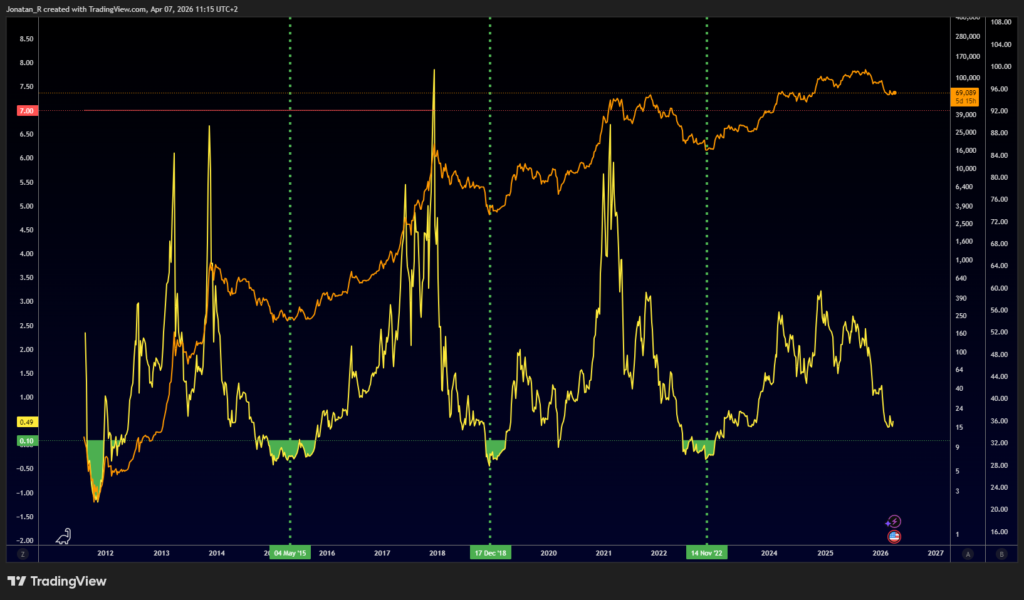
The MVRV Z-Score (yellow) at 0.49 is approaching the green undervaluation zone that has previously coincided with the three most recent cycle lows, overlaid against Bitcoin’s price (orange)
Weekly RSI: oversold, but that’s not the full picture
The Relative Strength Index (RSI) is a momentum oscillator that measures the speed and magnitude of recent price changes on a scale from 0 to 100. Readings below 30 are generally considered oversold, while readings above 70 are considered overbought. On the weekly timeframe, Bitcoin’s RSI has dropped to approximately 35.90, entering oversold territory for the first time since 6 June 2022.
Many traders could look at this reading and call it bullish, and historically, they have often been right. But it’s important to understand what oversold actually means, and more importantly, what it doesn’t mean.
Oversold does not guarantee a reversal. The last time Bitcoin’s weekly RSI entered oversold territory in June 2022, the price went on to fall a further 41.67% before finding its ultimate cycle low in November of that year. Momentum can remain stretched for extended periods, and an oversold reading simply tells us that selling pressure has been intense, not that it’s finished. Just because the rubber band is stretched to one side doesn’t mean it has to snap back immediately. This is something that can build gradually over weeks or even months.
It’s also important to remember that an extreme RSI reading can be a sign of a new strong trend emerging, not just a temporary overextension. In strong downtrends, RSI can stay pinned in the oversold zone while prices continue to decline.
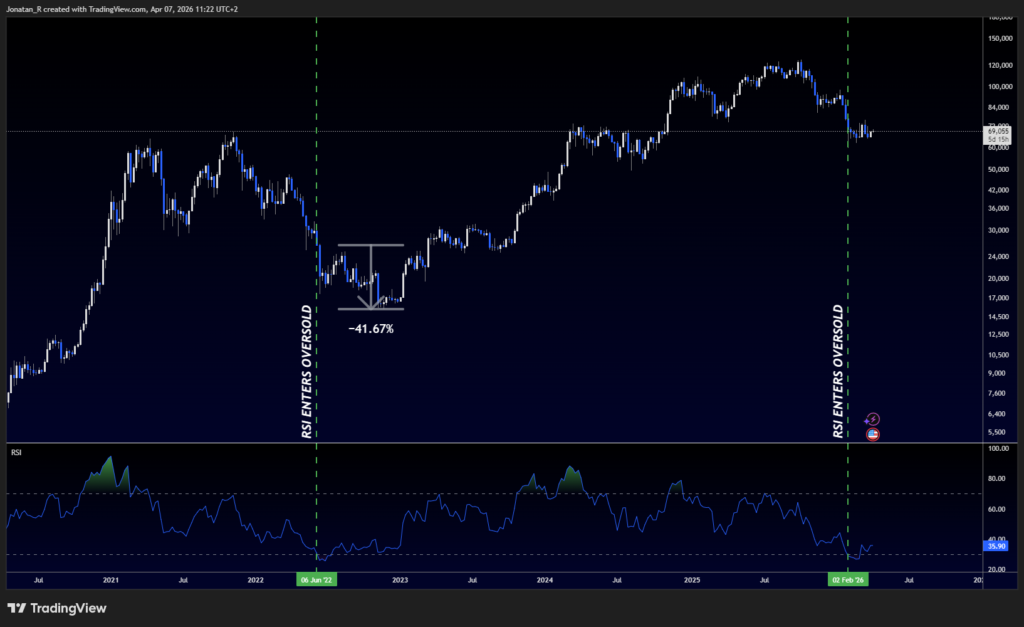
Bitcoin’s weekly RSI has entered oversold territory for the first time since June 2022, when prices went on to fall a further 41.67% before the cycle bottom.
What happens when we overlay RSI with the MVRV Z-Score?
This is where it gets particularly interesting. When we overlay the weekly RSI (blue) onto the MVRV Z-Score (yellow) and Bitcoin’s price (orange), a clear pattern emerges across previous cycles. At every major cycle bottom, two things have tended to happen at roughly the same time: the weekly RSI enters oversold territory, and the MVRV Z-Score drops into the green buy zone below 0.10.
In 2015, 2018, and 2022, these two signals aligned, both confirming that the market was not only losing momentum but also trading at or below the aggregate cost basis of holders. That confluence is what made those bottoms so significant.
Right now, for the first time in Bitcoin’s history, we have one signal but not the other. The weekly RSI has entered oversold territory, but the MVRV Z-Score at 0.49 remains above the green zone. This divergence could mean a few things:
- The correlation could be breaking down as Bitcoin matures and its market structure evolves with ETFs, institutional flows, and corporate treasury buyers changing the dynamics
- It could mean there is further downside ahead, with the MVRV Z-Score potentially needing to catch down to what the RSI is already signalling
- There could be a lag between the two indicators, and they may yet align in the weeks or months ahead
The key takeaway is that while the Realised Value compared to the Market Value of Bitcoin is still higher on average than what it typically is at cycle bottoms, the momentum is already stretched. We may need to see these two indicators converge before a high-conviction bottom signal is in place.
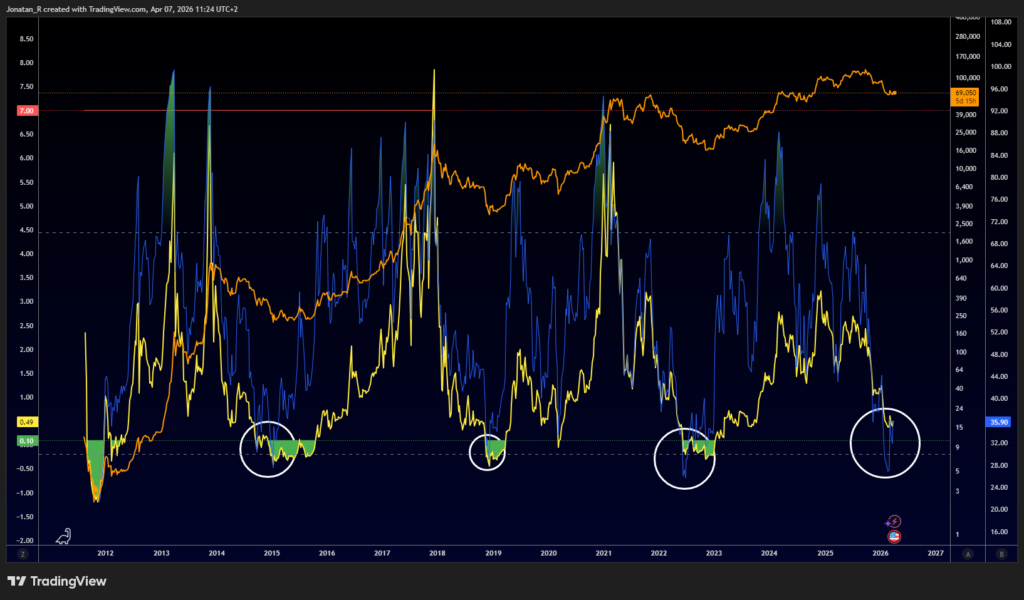
The weekly RSI (blue) has entered oversold territory while the MVRV Z-Score (yellow) remains above the historical buy zone, a divergence not seen at any of the four previous cycle lows (circled).
Global liquidity: the tide that lifts (or sinks) all boats
To understand where Bitcoin might be heading, we need to zoom out beyond on-chain metrics and look at the macro force that has historically driven the majority of Bitcoin’s price action: global liquidity.
Global liquidity refers to the overall availability of money and credit in the financial system. It encompasses central bank balance sheets, cross-border capital flows, Treasury market conditions, and private credit markets. Crucially, it’s not just about how much money exists in the system, but how available and accessible that money is. Liquidity is availability, not just quantity.
Research from CrossBorder Capital, led by macro strategist Michael Howell, suggests that global liquidity follows a roughly 65-month cycle (approximately 5.5 years) of expansion and contraction. According to their framework, the most recent cycle peaked around Q3 to Q4 2025, and we are now in the declining phase heading into 2026. This matters for Bitcoin because, according to Lyn Alden’s research, Bitcoin moves in the same direction as global liquidity approximately 83% of the time over any given 12-month period, a higher correlation than any other major asset class. Keyrock’s analysis puts it even more starkly: for every 1% change in global liquidity, Bitcoin has historically moved by roughly 7.6x over the following quarter, making it the most liquidity-sensitive asset in public markets.
However, since peaking in October 2025, Bitcoin has diverged from this relationship. Global M2 has continued to grow, yet Bitcoin’s price has roughly halved. Several factors are driving this divergence and the broader weakness in effective liquidity:
- The cyclical nature of liquidity itself. Liquidity moves through phases of expansion, tightening, contraction, and easing. We appear to be in the contraction phase of the current cycle, regardless of headline M2 figures.
- The debt refinancing wall. Old low-rate debt is being rolled over into new high-rate debt across governments and corporations. This absorbs liquidity into interest payments rather than productive investment or risk-asset speculation. The US alone faces $3 to $4 trillion in annual refinancing needs through 2029.
- The oil and inflation shock. The ongoing Iran conflict and the resulting spike in crude oil prices have pushed inflation expectations higher, tying central banks’ hands and preventing the kind of aggressive easing that could typically boost liquidity at this stage of the cycle. The Fed remains on hold at 3.50% to 3.75%, with the dot plot projecting just one cut in 2026.
- The shift from monetary to fiscal dominance. Governments are increasingly driving liquidity through fiscal spending and deficit financing rather than through central bank intervention. This changes the transmission mechanism and makes liquidity less directly supportive of financial asset prices.
- Geopolitical shocks. The war in Iran, Strait of Hormuz disruptions, and broader geopolitical uncertainty increase volatility and reduce risk appetite, causing capital to retreat from speculative assets regardless of underlying liquidity conditions.
The important nuance is that Bitcoin’s post-ETF market structure has introduced a new variable. Institutional ETF flows now act as a significant transmission channel between macro conditions and Bitcoin’s price. When those flows reverse, as they did in early 2026, Bitcoin can temporarily trade like a macro-sensitive institutional product with large flow shocks rather than purely tracking the broader liquidity tide.
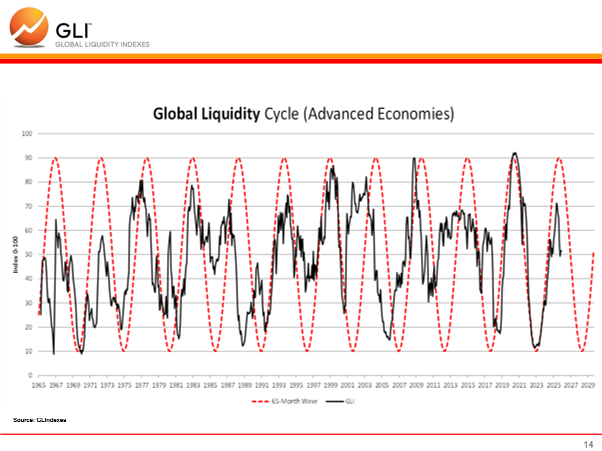
The global liquidity cycle from CrossBorder Capital shows the current cycle peaking in late 2025 and now entering its declining phase, historically a headwind for risk assets and particularly for Bitcoin given its outsized sensitivity to liquidity conditions.
The business cycle: where are we now?
The final piece of the macro puzzle is the business cycle itself. For this, we turn to the ITC Business Cycles indicator from Into the Cryptoverse, created by Benjamin Cowen. This model normalises the business cycle by M2 money supply, stripping out the effects of monetary expansion to show the “real” cyclical position of the economy.
As of 31 March 2026, the indicator reads 0.135, near the lower end of its historical range. What stands out on this chart is the pattern that has repeated across six decades: the grey-shaded US recession bars tend to appear shortly after or during a sharp decline in the business cycle indicator. We can see this in the early 1970s, early 1980s, early 1990s, 2001, 2008, and 2020.
The current reading suggests we are in the late-expansion or early-slowdown phase of the cycle. The indicator has been declining since its post-pandemic peak around 2021, and when normalised against M2, economic activity relative to the money supply is approaching levels historically associated with recessionary conditions.
For Bitcoin, this matters because recessions and the policy responses they trigger, namely rate cuts and renewed quantitative easing, are what historically reignite the next liquidity cycle. If the business cycle continues to deteriorate from here, the pressure on the Fed and other central banks to pivot from tightening to easing increases significantly. That pivot is what has historically provided the fuel for Bitcoin’s most explosive rallies.
In other words, the business cycle is telling a similar story to the liquidity data: the near-term environment remains challenging, but we may be approaching the point in the cycle where the conditions for the next major upswing begin to take shape.
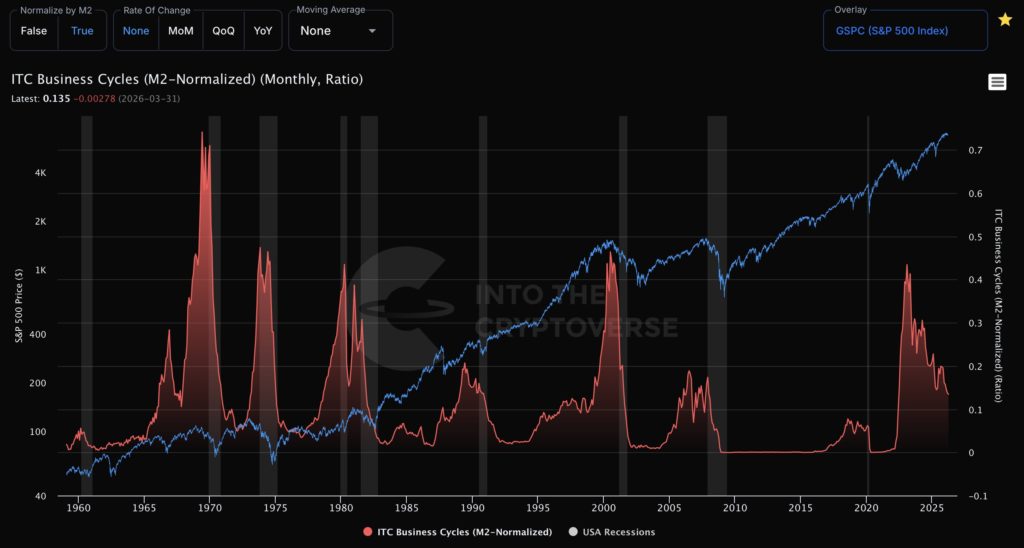
The ITC Business Cycles indicator (M2-normalised) from Into the Cryptoverse by Benjamin Cowen shows the current reading at 0.135, approaching levels historically associated with recessionary conditions and the policy pivots that follow.
Tying it all together: the macro case for patience
Every indicator we’ve examined in this article is telling a version of the same story, but from a different angle.
The MVRV Z-Score at 0.49 shows that Bitcoin is approaching historically undervalued territory, but hasn’t yet reached the extreme levels that marked the 2015, 2018, and 2022 cycle bottoms. The weekly RSI has entered oversold territory for the first time since June 2022, but as we saw then, oversold momentum doesn’t guarantee an immediate reversal, and the divergence between RSI and the MVRV Z-Score is something we haven’t seen before at previous cycle lows. Global liquidity, the single most important macro driver of Bitcoin’s price over time, is in the declining phase of its roughly 65-month cycle, creating a headwind that could persist through the first half of 2026. And the business cycle, when normalised against M2, is approaching levels historically associated with economic slowdowns and the policy pivots that follow.
The picture that emerges is one of building long-term value against a challenging near-term backdrop. Bitcoin could be in the process of forming a macro bottom, but the liquidity environment and business cycle suggest that the catalyst for the next sustained move higher, likely a shift toward monetary easing, may still be some months away. The structural setup is there: a $3 to $4 trillion annual US debt refinancing wall, a Fed that has signalled willingness to cut, and a business cycle approaching the point where intervention historically becomes necessary. But the timing remains uncertain, and patience could be rewarded.
For long-term investors, the convergence of a low MVRV Z-Score, oversold momentum, and a maturing business cycle is the kind of setup that has historically preceded Bitcoin’s strongest multi-year returns. For shorter-term traders, the absence of a liquidity tailwind and the RSI/MVRV divergence suggest caution until these signals begin to align.
Key levels to watch:
- MVRV Z-Score dropping below 0.10 could confirm entry into the historical buy zone and align with the oversold RSI signal
- A Fed pivot toward rate cuts, currently projected for the second half of 2026 at the earliest, could mark the beginning of the next liquidity expansion
- The ITC Business Cycle indicator declining further toward or below zero could increase the probability of a recession and the aggressive policy response that typically follows
We’re covering all of these concepts in more detail in today’s live analysis session, looking at the live price of Bitcoin and walking through these charts in real time. Make sure to tune in to our live streams, which we host regularly on our YouTube channel. Click the link below to watch today’s session where this subject is being covered live.
Trading involves risk.
Author



 Risk Disclaimer
The content provided here is for informational purposes only. It is not intended as personal investment advice and does not constitute a solicitation or invitation to engage in any financial transactions, investments, or related activities. Past performance is not a reliable indicator of future results.
The financial products offered by the Company are complex and come with a high risk of losing money rapidly due to leverage. These products may not be suitable for all investors. Before engaging, you should consider whether you understand how these leveraged products work and whether you can afford the high risk of losing your money.
The Company does not accept clients from the Restricted Jurisdictions as indicated in our website/ T&C. Some services or products may not be available in your jurisdiction.
The applicable legal entity and its respective products and services depend on the client’s country of residence and the entity with which the client has established a contractual relationship during registration.