6 min read
Gold (XAU/USD) surged to a three-week high above $4,850 on Wednesday after the US and Iran agreed to a two-week ceasefire, but gains quickly faded as the deal began to unravel. Spot gold has since pulled back to around $4,715.
Here is what you need to know:
- Gold spiked over 3% to above $4,850 before pulling back sharply as the ceasefire frayed
- Israel launched its largest coordinated strike of the war in Lebanon hours after the announcement, killing at least 254 people
- Iran says three clauses have been breached and the IRGC warned it could resume fighting
- The US and Iran disagree on whether Lebanon is included in the deal, with mediator Pakistan saying it is and Washington and Israel saying it is not
- The Strait of Hormuz remains largely blocked despite Iran’s assurances of safe passage
- Q4 GDP and Core PCE data are due today, following yesterday’s FOMC minutes
As we covered in our previous gold analysis, gold has been recovering from its worst month in over a decade, losing more than 10% in March as the war drove oil prices higher and forced a hawkish repricing across rate markets.
The ceasefire initially looked like it could accelerate that recovery. Lower oil prices would ease inflation expectations, reopen the door for Fed rate cuts, and weaken the dollar, all of which are bullish for gold. That is exactly what played out on Wednesday, with Treasury yields falling and the dollar pulling back.
But the deal started crumbling almost immediately. Israel struck more than 100 targets across Lebanon within hours, Prime Minister Netanyahu stated the ceasefire does not cover Hezbollah, and Iran’s Foreign Minister Araghchi responded that the US “must choose, ceasefire or continued war via Israel.” Reports emerged that tanker traffic through the Strait was suspended again, and talks are now scheduled for Islamabad on Friday.
This matters for gold because of how the metal has traded throughout this conflict. Rather than rallying on war headlines as a traditional safe haven, gold has sold off as surging oil fuelled inflation fears, pushed yields higher, and strengthened the dollar, increasing the opportunity cost of holding a non-yielding asset. The ceasefire reversed that dynamic. But if the deal collapses and oil spikes again, the same pressure could return.
Yesterday’s FOMC minutes reinforced the Fed’s cautious stance, with the dot plot showing just one cut as the median expectation and seven of nineteen participants seeing no cuts at all in 2026. Goldman Sachs recently reiterated its $5,400 year-end gold target, arguing the structural case remains intact.
4-hour chart analysis
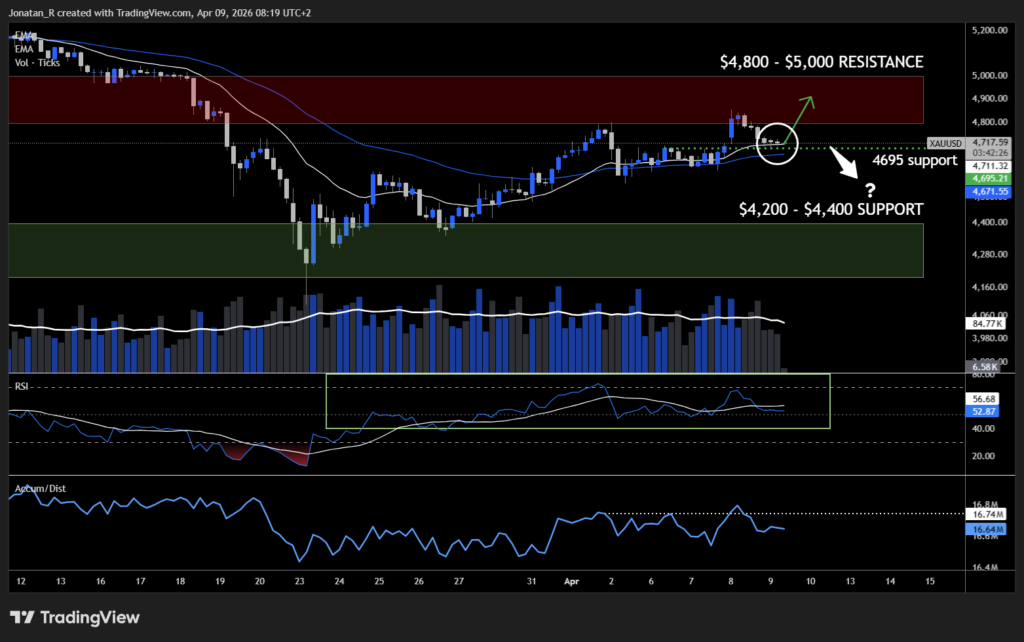
The 4-hour chart shows gold pulling back from the ceasefire-driven spike above $4,850, with the RSI re-entering its bullish range but the Accumulation/Distribution indicator warning that volume is not confirming the local uptrend.
On the 4-hour timeframe, gold has been building a local uptrend since bouncing off the $4,300 support level. Price rallied in a series of higher lows before tapping the higher-timeframe resistance around $4,800, where the ceasefire spike to $4,850 marked the local high.
The RSI has re-entered its bullish range (the 40 to 80 zone, per Cardwell’s framework), with 40 now acting as the support floor for momentum. This is a meaningful shift in character from the bearish range that dominated during March’s selloff.
However, the Accumulation/Distribution indicator is telling a more cautious story. Volume has been declining throughout this local uptrend, and the A/D line has now fallen back within its previous range prior to the breakout. This suggests the rally lacks full buying conviction and may not be sustainable without fresh volume.
The key levels to watch on the 4-hour:
- $4,695 is the immediate support, sitting between the 4-hour 20 and 50 EMAs. Holding here keeps the local uptrend intact
- $4,800 to $4,850 is the resistance zone where the ceasefire spike was rejected
- $4,400 is the next major support if $4,695 fails, which would likely confirm the local uptrend has broken down
The bottom line: the ceasefire gave gold a boost by easing the oil-driven inflation pressure that has weighed on the metal throughout this conflict. But the deal is already under serious strain. The RSI shift is encouraging, but declining volume on the A/D indicator suggests caution. A hold above $4,695 keeps the structure intact, while a failure there, particularly if the ceasefire collapses and oil spikes again, could open the door to $4,400.
Trading involves risk.
Author



 Risk Disclaimer
The content provided here is for informational purposes only. It is not intended as personal investment advice and does not constitute a solicitation or invitation to engage in any financial transactions, investments, or related activities. Past performance is not a reliable indicator of future results.
The financial products offered by the Company are complex and come with a high risk of losing money rapidly due to leverage. These products may not be suitable for all investors. Before engaging, you should consider whether you understand how these leveraged products work and whether you can afford the high risk of losing your money.
The Company does not accept clients from the Restricted Jurisdictions as indicated in our website/ T&C. Some services or products may not be available in your jurisdiction.
The applicable legal entity and its respective products and services depend on the client’s country of residence and the entity with which the client has established a contractual relationship during registration.