6 min read
Bitcoin (BTC/USD) is trading around $68,000 after a brutal start to February that saw the price drop from above $72,000 to a low near $60,000 in the space of just a few sessions. Since that flush, the price has been grinding higher, forming a pattern on the lower time frames that could set up the next significant move. But before jumping to conclusions, it’s worth zooming out to understand the broader structure, because what’s happening on the 4-hour chart only tells part of the story. Let’s start with the lower time frame and work our way up.
4-hour ascending triangle
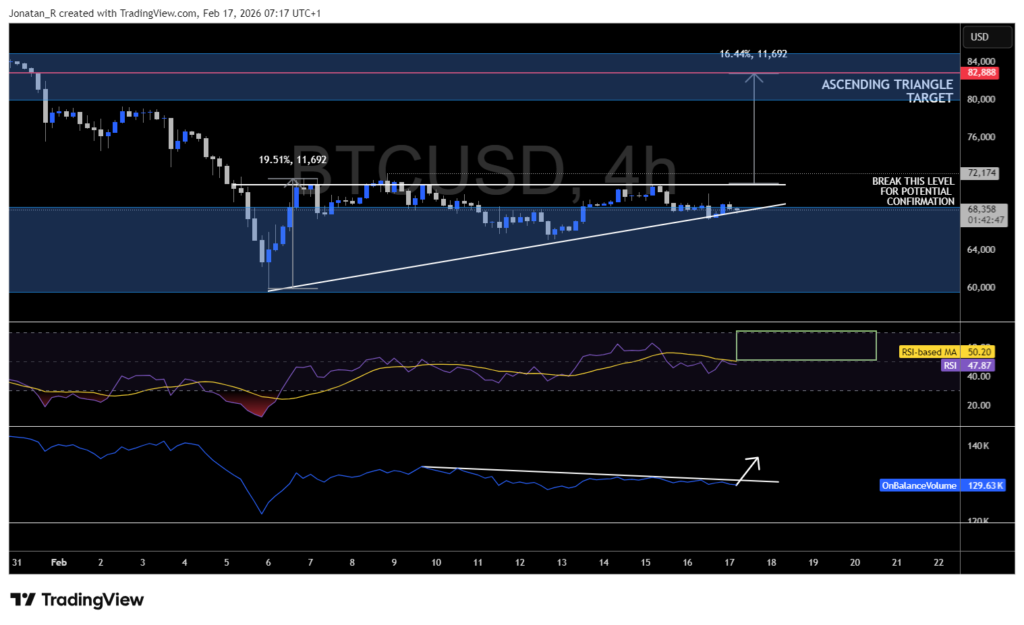
After the drop to $60,000 in early February, Bitcoin has been forming an ascending triangle on the 4-hour time frame, with higher lows pressing into flat resistance around the $71,000 region. The pattern is now approaching its apex, which typically means a resolution is coming soon.
The measured move of this ascending triangle is worth paying attention to. By measuring the distance between the low of the pattern and the high, then projecting that distance from a potential breakout point, the target lands around the $83,000 region. What makes this interesting is that $83,000 lines up almost perfectly with high time frame resistance above, which we’ll cover in the weekly chart section below.
Looking at the RSI in the middle panel, the indicator is currently sitting at around 47, below the 50% level. The RSI has been ranging between the 50% area and the oversold zone, which is typical behaviour for a bearish market structure. What bulls would need to see here is an RSI break above 50 and for it to start trading within the upper range between the 50% level and the overbought level. This would create what’s known as a Cardwell RSI range shift, a signal that momentum is potentially transitioning from bearish to bullish.
Shifting attention to the On Balance Volume (OBV) at the bottom of the chart, the indicator is in a clear downtrend. A break of that descending trend line and a structural shift into higher highs and higher lows on OBV could signal that buying pressure is starting to build. If this happens before a breakout from the ascending triangle, it could provide an early hint that the pattern is more likely to resolve to the upside.
One important note on the pattern itself. A traditional ascending triangle is a bullish continuation pattern where price enters from below, meaning the trend heading into the triangle is already bullish. In this case, Bitcoin entered the pattern from above, coming off a steep decline from the October highs. That changes the probability profile of the pattern significantly. It could still break out to the upside, but the fact that the entry is from above rather than below means that a breakout carries less statistical weight than a textbook ascending triangle would.
For this reason, confirmation is crucial. The ascending triangle is only valid after an actual breakout above the flat resistance. Even then, it’s important to understand that a breakout to the upside would still be a counter-trend trade within the context of a larger downtrend. This is worth remembering when it comes to risk management, including position sizing and expectations for follow-through.
Weekly market structure
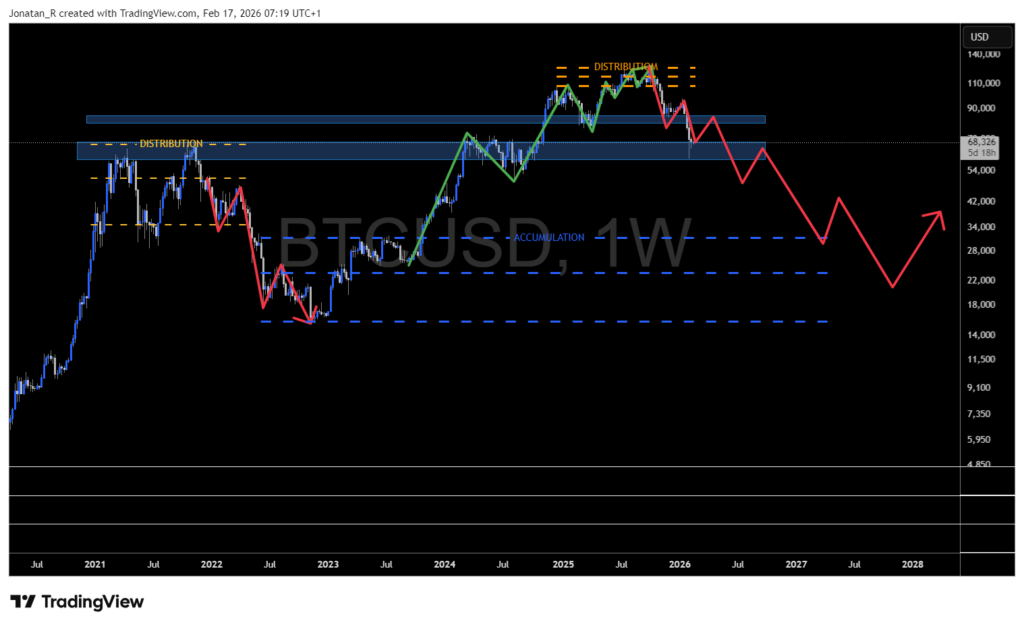
Zooming out to the weekly time frame gives crucial context to the ascending triangle forming on the 4-hour chart. Bitcoin hit an all-time high near $126,000 in October 2025 and has been in a structural downtrend since, losing nearly half its value in four months. The current price around $68,000 is sitting right at a historically significant zone that acted as distribution back in 2021.
Looking at the broader structure through the lens of Dow Theory, markets tend to move in cycles between accumulation and distribution phases. The rally from the 2022 lows near $15,000 through the 2024-2025 bull run appears to have reached a distribution phase at the highs above $100,000. If that distribution is confirmed, the next phase in the cycle would be a continued downtrend toward a new accumulation zone. Nobody knows how far that downtrend could extend or where the eventual bottom will be, but the structure on the weekly chart suggests that the path of least resistance currently remains to the downside.
This is the context that matters when looking at the 4-hour ascending triangle. Even if the pattern breaks out and Bitcoin reaches the measured move target around $83,000, that level could simply mark a lower high on the weekly time frame before the broader downtrend resumes. There’s a well-known saying in trading: “the trend is your friend.” For Bitcoin right now, the primary dominant trend on higher time frames is to the downside, and successful trend-following approaches would suggest staying aligned with that direction until the structure changes.
Trading involves risk.
Author



 Risk Disclaimer
The content provided here is for informational purposes only. It is not intended as personal investment advice and does not constitute a solicitation or invitation to engage in any financial transactions, investments, or related activities. Past performance is not a reliable indicator of future results.
The financial products offered by the Company are complex and come with a high risk of losing money rapidly due to leverage. These products may not be suitable for all investors. Before engaging, you should consider whether you understand how these leveraged products work and whether you can afford the high risk of losing your money.
The Company does not accept clients from the Restricted Jurisdictions as indicated in our website/ T&C. Some services or products may not be available in your jurisdiction.
The applicable legal entity and its respective products and services depend on the client’s country of residence and the entity with which the client has established a contractual relationship during registration.