19 min read
 The All Pakistan Sarafa Gems and Jewellers Association quoted PKR 457,536 per tola for 24K gold on 22 September 2026, down PKR 2,700 on the day. Behind that fall sits a policy reversal: on 16 September the Federal Reserve raised interest rates for the first time since 2023, unanimously, and its own projections now point to another hike this year rather than a cut. Gold lost about 7% over the month. Gold (XAU/USD on PrimeXBT) hedges currency debasement and real-rate risk, and what a Pakistani buyer pays is that international price converted at one clean ratio and marked up by a small local premium. This page forecasts the Pakistani rate through 2030 and out to 2040, in rupees per tola.
Gold outlook at a glance
- Current price: gold trades at $4,131.01 per troy ounce, 0.14% over the last 24 hours.
- 2026 base case: PKR 432,300–504,600 per tola for 24K over the rest of the year, centred near PKR 469,400 by December.
- What analysts say: Goldman cut year-end 2026 to $4,650 from $4,900 on 19 September, the only revision since the hike, while the LBMA’s July panel averaged $4,500 and J.P. Morgan’s public page still shows $6,000 on a note dated 9 June.
- Biggest downside risk: the 10-year US real yield has risen to 2.62% from 2.42% in early September, and if the Fed delivers the second hike its dot plot implies, the $4,230 floor that held twice is what decides whether this is a correction.
- Long-term view: compounding below gold’s historical nominal return points to about PKR 628,400 per tola by 2030 and PKR 976,000 by 2040 — a direction and a band, not a committable price.
Live gold chart
Trading involves risk.
What actually sets the gold rate in Pakistan
Pakistan’s gold rate has the cleanest arithmetic of any major market, because one tola is not an awkward conversion. A tola is 180 troy grains, or exactly three-eighths of a troy ounce — 11.6638 grams. So the import-parity price is a single multiplication. On 22 September 2026: $4,350 per troy ounce × 0.375 = $1,631.25 per tola; at the State Bank’s mark-to-market rate of 277.2138 that is PKR 452,205. The association published PKR 457,536. The gap is 1.2%, and that is the whole story — no duty stack, no layered sales tax, just a small premium over import parity.
That makes Pakistan the mirror image of India, where duty and GST open a wedge of about 18% between converted spot and what a buyer pays. The reason here is uncomfortable rather than efficient: there is no general commercial import channel to tax. The State Bank’s Foreign Exchange Manual prohibits importing bullion without its permission, and the only working route is the entrustment scheme under SRO 760(I)/2013, suspended in May 2025 and restored on 21 November 2025 by Ministry of Commerce SRO 2198.
One trap in the published rates: the association’s 22K, 21K and 18K lines are exact fractions of the 24K figure — 22/24, 21/24, 18/24. They are conversions, not observed prices, and they carry no making charges, so a finished 22K piece costs more than that line implies.
Gold rate prediction in Pakistan: 2026–2030
PrimeXBT’s central case puts the Pakistani gold rate near PKR 628,400 per tola for 24K by 2030, from PKR 457,536 on 22 September 2026. These figures sit on the association-benchmark basis, so they compare to the APSGJA rate rather than to a jeweller’s bill, and they assume the local premium over the international price stays where it is.
| Year | Minimum, 24K | Average, 24K | Maximum, 24K | Average, 22K | Average, 21K |
|---|---|---|---|---|---|
| 2026 (Oct–Dec) | PKR 424,800 | PKR 464,600 | PKR 504,500 | PKR 425,900 | PKR 406,600 |
| 2027 | PKR 405,800 | PKR 520,000 | PKR 634,300 | PKR 476,700 | PKR 455,000 |
| 2028 | PKR 438,900 | PKR 570,000 | PKR 701,100 | PKR 522,500 | PKR 498,800 |
| 2029 | PKR 427,900 | PKR 598,500 | PKR 769,100 | PKR 548,600 | PKR 523,700 |
| 2030 | PKR 414,800 | PKR 628,400 | PKR 842,100 | PKR 576,100 | PKR 549,900 |
All figures are rupees per tola. Per 10 grams, divide by 1.16638 — the 2030 average for 24K becomes about PKR 538,800. The 2026 and 2027 rows come out of the monthly tables below: lowest monthly minimum, mean of the averages, highest maximum, with 2026 covering October to December only. The bands widen with horizon because a four-year forecast is less certain than a three-month one, not because of anything more complicated than that.
Gold price prediction 2026
PrimeXBT’s base case puts the rate near PKR 469,400 per tola for 24K by December 2026, against PKR 457,536 on 22 September. That is a modest step up, and it sits below the analyst surveys deliberately: the LBMA’s July panel and the Reuters poll of 29 analysts were both taken before the Fed turned. Goldman is the only house to have re-priced since, cutting on 19 September, and we sit under it because the dot plot implies a second hike and gold has lost its 200-day average.
| Month (2026) | Minimum | Average | Maximum |
|---|---|---|---|
| October | PKR 432,300 | PKR 459,900 | PKR 487,500 |
| November | PKR 433,500 | PKR 464,600 | PKR 495,800 |
| December | PKR 434,200 | PKR 469,400 | PKR 504,600 |
Rupees per tola of 24K. Two Fed meetings and three US inflation prints land inside this window, so the narrow band reflects a short horizon, not a settled outcome.
Gold price prediction 2027
PrimeXBT’s 2027 path ends near PKR 542,900 per tola for 24K, which in dollar terms is the bottom of the published analyst cluster — Goldman kept end-2027 at $5,400 even while cutting 2026, HSBC published about $5,025 on 9 July, and Société Générale and State Street both see $5,000. We anchor below all of them because the September projections show no cuts in 2027: the median dot sits at 4.1%, with more participants above it than below.
| Month (2027) | Minimum | Average | Maximum |
|---|---|---|---|
| January | PKR 440,000 | PKR 497,200 | PKR 554,300 |
| February | PKR 441,200 | PKR 501,300 | PKR 561,500 |
| March | PKR 442,300 | PKR 505,500 | PKR 568,700 |
| April | PKR 443,400 | PKR 509,600 | PKR 575,900 |
| May | PKR 444,400 | PKR 513,800 | PKR 583,200 |
| June | PKR 445,400 | PKR 517,900 | PKR 590,500 |
| July | PKR 446,400 | PKR 522,100 | PKR 597,800 |
| August | PKR 447,300 | PKR 526,300 | PKR 605,200 |
| September | PKR 448,200 | PKR 530,400 | PKR 612,600 |
| October | PKR 449,000 | PKR 534,600 | PKR 620,100 |
| November | PKR 449,800 | PKR 538,700 | PKR 627,600 |
| December | PKR 450,600 | PKR 542,900 | PKR 635,200 |
Rupees per tola of 24K.
Gold rate in 2030 in Pakistan
PrimeXBT’s 2030 anchor is about PKR 628,400 per tola for 24K. Beyond 2027 there is no institutional target to lean on — we looked for published 2028, 2029 and 2030 forecasts from named banks and found none, and what circulates instead is algorithmic-aggregator output under analyst-sounding headings. So the model compounds at 5% a year from the 2027 anchor, putting 2028 at PKR 570,000 and 2029 at PKR 598,500 per tola: the lower half of a band bounded above by gold’s long-run nominal return of roughly 8% a year since 1971, because a restrictive real-rate regime is now the base case rather than the risk case.
That is roughly 37% above the September 2026 rate, spread over four years, or about 8% a year compounded. For a metal that has just fallen 7% in a month and lost its 200-day average, that is a recovery-then-grind path rather than a continuation of the 2024–25 run.
Gold rate prediction for 2040, and the 2035 waypoint
Past 2030 this is a statement about compounding, not a forecast, so it gets one range per year and no false precision. From 2031 the model slows to 4.5% a year because gold enters the horizon expensive in real terms: it cleared its January 1980 peak in inflation-adjusted dollars only in 2025, forty-five years later, and has already given back a quarter of that gain.
| Year | PKR per tola, 24K | PKR per 10 grams, 24K |
|---|---|---|
| 2035 | 419,000 – 1,147,000 | 359,000 – 983,000 |
| 2040 | 425,000 – 1,527,000 | 364,000 – 1,309,000 |
The low end deserves a stare: a 2040 floor near PKR 425,000 is below today’s rate, and it is there because a long stretch of no progress has happened before — gold fell about 70% from $850 an ounce in January 1980 to around $252 in July 1999. A long-run table with no flat scenario is selling something.
What analysts expect
Named gold targets for 2026 span roughly $4,360 to $6,000, and most of that spread is a calendar effect rather than a disagreement. Everything published before 16 September assumed a Fed that was finished hiking. Only one house has re-priced since.
| Source | Target | Horizon | Date of call | Change |
|---|---|---|---|---|
| Goldman Sachs | $4,650 | year-end 2026 | 19 September 2026 | cut from $4,900, citing the hike |
| Goldman Sachs | $5,400 | end-2027 | 19 September 2026 | maintained |
| LBMA Snapshot Survey (16 analysts) | $4,500 / $4,604 | year-end 2026 / 2026 average | 11 August 2026 | panel high cut from $7,150 to $5,100 |
| Reuters / LSEG poll (29 analysts) | $4,509 | 2026 full-year median | 29 July 2026 | cut from $4,916 |
| Reuters / LSEG poll | $4,610 | 2027 full-year average | 29 July 2026 | — |
| Citi | $4,800 | 0–3 month | 24 August 2026 | — |
| Morgan Stanley | $4,450 | Q4 2026 | 20 August 2026 | — |
| Deutsche Bank | $4,600 | Q4 2026 | 3 August 2026 | held; from $6,000 in January |
| HSBC | $4,750 / ~$5,025 | year-end 2026 / year-end 2027 | 9 July 2026 | both cut |
| Bank of America | $4,360 | 2026 average | 8 July 2026 | — |
| UBS | $5,200 | 12-month | May 2026 | lowered from $5,900 |
| Société Générale | $5,000 | Q2 2027 | 19 June 2026 | — |
| J.P. Morgan | $6,000 / $6,263 | Q4 2026 / 2027 average | 9 June 2026 | page not updated since |
Goldman’s reasoning matters more than its number: it argues the hikes should “slow the rally rather than derail it entirely,” pointing to central-bank buying near 91 tonnes a month as the offset. That is testable, and the World Gold Council’s Q3 demand data in late October is the test.
And J.P. Morgan’s public gold page is stale. It ranks near the top of Google for several gold forecast queries, carries a date of 9 June 2026, and still shows $6,000 for the fourth quarter — roughly 39% above the market. Anyone building a view from that page alone is quoting a number set one policy reversal ago.
Will gold rates decrease in the coming days in Pakistan?
This page is reviewed once a month and does not forecast individual days, which is the honest answer to a question asked daily. What can be said is what the setup looks like. Gold has fallen about 7% over the past month, sits below its 200-day moving average, and $4,400 has flipped from support into resistance — buyers failed to reclaim it on 21 September. Below, $4,230 held in early August and again on 16 September. That level, not any single day’s move, separates a correction from something larger.
The domestic rate has a second gate. Because the rupee has been stable and reserves are at a five-year high, Pakistani prices have tracked dollar gold closely rather than being pushed around by the currency — unusual here, and not necessarily durable. Over days the gold price does the work; over years the rupee does at least half of it.
Technical picture
Gold trades below its 200-day moving average and around its 50- and 100-day averages, which is what a market looks like after breaking down and trying to stabilise. Sources disagree on the 200-day by a wide margin — readings on 21 September ranged from about $4,343 to $4,550 — and the lower figure cannot be right, since a window containing January’s $5,608 peak cannot average below spot. Treat it as roughly $4,550, and the disagreement as a reason not to trade a single number.
Resistance sits at $4,400, then the 3 September high near $4,510. Support is $4,230, the August and September lows, then the $4,000 level below it. RSI read between 48 and 51 across two sources on 21 September, unable to hold above its midline. All figures are spot XAU/USD as at publication; the chart above carries the live picture.
How gold moves with other assets
The textbook relationship reasserted itself this month, having been broken for most of the year. The 10-year US real yield rose from 2.42% on 3 September to 2.62% on 21 September — twelve basis points into the 11 September inflation print, the rest on the Fed’s decision — and gold fell roughly 7% across the same stretch. That is the mechanism working as described, after a year in which gold rose alongside rising real yields and left everyone reaching for explanations.
The dollar did its part: the DXY index reclaimed and held 100. The S&P 500 has returned about 14% in 2026 with the Nasdaq setting a record close on 21 September — gold is the asset that fell while risk assets did not. There is a case for holding gold alongside bitcoin, and PrimeXBT has made it separately, but it is diversification rather than substitution. Silver fell less, tightening the ratio to about 66.
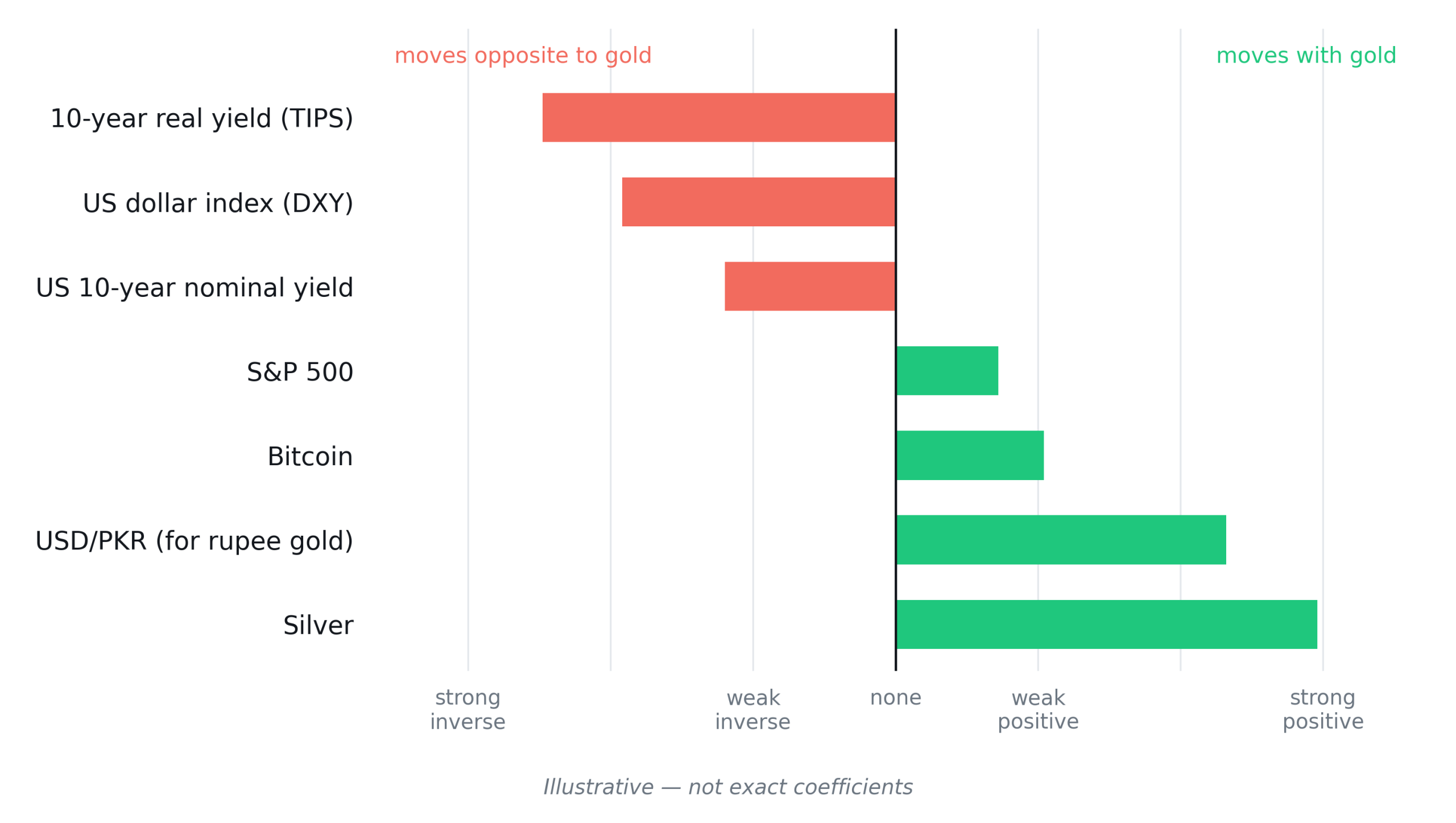
Read the chart as directions, not constants. Every one of these relationships has inverted for months at a time.
What drives the gold price
Real rates and the Fed. Gold pays nothing, so the cost of holding it is whatever an inflation-protected bond yields, and at 2.62% that cost is the highest of this cycle. The September projections put the median 2026 policy rate at 4.1% against a current 3.75–4.00% range, and sixteen of the eighteen policymakers who submitted projections now see another quarter-point rise this year, against six in June.
Official-sector and ETF demand. Central-bank buying is the structural support, and Goldman puts the run rate near 91 tonnes a month. ETF holdings hit a record 4,189 tonnes in August, adding 121 tonnes with Europe posting its largest month ever — but that published on 9 September, before the hike, and the price has fallen since. It is a lagging indicator.
Physical demand, and Pakistan’s share. Pakistan consumed 35.2 tonnes in 2025 on World Gold Council figures: 15.8 tonnes of jewellery, down 10%, against 19.4 tonnes of bars and coins, up 2%. The second quarter of 2026 widened the split — jewellery fell 15% while bar and coin rose 5%. Pakistan is an investment market rather than a jewellery market, and has been since 2024.
Pakistan’s gold market is mostly informal, and that matters for the price
The Competition Commission of Pakistan’s competition assessment study, reported in November 2025, found that more than 90% of gold trading occurs outside formal channels, put annual consumption at 60 to 90 tonnes, and recorded gold imports of just $17 million in FY2023-24. It also noted that daily rates are “largely influenced by associations rather than transparent market mechanisms,” and recommended a unified gold authority, mandatory assaying and supply-chain digitisation.
Two consequences follow. The 60–90 tonne estimate is roughly double the World Gold Council’s 35 tonnes of recorded demand, and the difference is undocumented trade — so any Pakistan demand figure needs its source attached. And the benchmark this page forecasts is an association quote, not a cleared exchange price: it tracks import parity at a 1.2% premium, which is why the model works, but that rests on convention rather than on arbitrage anyone can execute.
Catalyst calendar
| Date | Event | Why it matters for gold |
|---|---|---|
| 14 October 2026 | US CPI, September | Feeds the real-rate calculation directly |
| 26 October 2026 | SBP Monetary Policy Committee | Rupee and domestic rates |
| 27–28 October 2026 | FOMC meeting | No projections at this meeting |
| Late October 2026 (date not yet confirmed) | WGC Gold Demand Trends, Q3 | Tests Goldman’s central-bank-buying claim |
| 8–9 December 2026 | FOMC meeting, with projections | Where the second 2026 hike would land |
| 14 December 2026 | SBP Monetary Policy Committee | Last SBP decision of 2026 |
| January 2027 (date not yet confirmed) | LBMA Annual Forecast Survey | The only published survey of named precious-metals analysts |
| 26–27 January 2027 | FOMC meeting | — |
| Around 8 February 2027 (subject to moon sighting) | Ramadan expected to begin | Seasonal demand period |
| Around 9 March 2027 (subject to moon sighting) | Eid al-Fitr expected | — |
| 16–17 May 2027 (subject to moon sighting) | Eid al-Adha expected | — |
Only confirmed, dated events are listed. FOMC dates follow the Federal Reserve’s published schedule, which notes each date is tentative until confirmed at the preceding meeting; US inflation dates follow the Bureau of Labor Statistics schedule, which does not yet cover 2027; SBP dates come from the Committee calendar, which runs to June 2027. Islamic dates are astronomical estimates — Pakistan’s Central Ruet-e-Hilal Committee determines them by local sighting, often a day after Saudi Arabia — so they are expected, not fixed. PrimeXBT’s economic calendar tracks releases as they land.
Bull case and bear case
The bull case. Central-bank buying near 91 tonnes a month is a bid that does not care about the policy rate. ETF holdings set a record in August. Goldman kept end-2027 at $5,400 through the hike, judging that tighter policy slows the move rather than ending it. And rupee depreciation toward BMI’s 292 would lift the tola rate even on a flat dollar price.
The bear case. The Fed is hiking, not cutting, and its projections show no relief in 2027. Real yields at 2.62% are the highest of the cycle. Gold has lost its 200-day average and printed a lower high. And Pakistani jewellery demand fell 15% year on year in the second quarter, with traders quoted by Al Jazeera in April reporting sales down roughly half over a year as buyers moved to 18K and gold-plated pieces.
The deciding levels come from the technical section. The bull case weakens on a sustained close below $4,230 per troy ounce, the floor that has held twice. The bear case stops working above $4,550, the 200-day area, because that is where a broken market stops looking broken.
Historical gold returns, in dollars and in rupees
Gold has returned roughly 8% a year in nominal dollar terms since 1971 and about 4% in real terms over 1971 to 2023, on World Gold Council and SUERF research. The distinction is not academic: the January 1980 peak of $850 an ounce is worth around $3,325 in today’s money on annual CPI averages, and gold cleared that inflation-adjusted level only in 2025, forty-five years later. It then set a record $5,608 in January 2026 and has given back roughly a quarter. The World Gold Council counts five major bear markets since 1971, with month-end declines of 42% to 52%.
In rupees, currency has flattered the picture for most of two decades, and this year it has not. SBP-held reserves reached $21.4 billion in the week to 11 September, a level the central bank has not seen before, and the rupee has been broadly stable. So a Pakistani holder’s 2026 return is close to the dollar return: for once the currency is not doing the work.
Is gold a good investment in Pakistan, and which form?
The forms differ enough in cost and liquidity that the question cannot be answered without saying which gold. What follows describes the differences; it does not recommend one.
Physical. Bars, coins and jewellery pay no income, need storage, and carry a spread that widens once making charges enter; resale is at a discount to the quoted rate. With more than 90% of the trade outside formal channels, assaying and provenance are real risks — the Competition Commission recommended mandatory hallmarking precisely because it is not yet standard.
Gold CFDs. What PrimeXBT offers, and a different instrument rather than a cheaper version of the above. A contract for difference tracks the price without conveying ownership, can be held long or short, uses leverage and carries overnight financing. A 2030 forecast is not a reason to open a leveraged position today. PrimeXBT’s guide to investing in gold in Pakistan covers the local options.
How to trade gold on PrimeXBT
Gold trades on PrimeXBT as a commodity CFD under the symbol XAU/USD, quoted in US dollars per troy ounce, with a live chart and order entry. Because a CFD works in both directions, the direction of any forecast is beside the point.
Some mechanics are specific to commodity CFDs. A daily trading break means positions carry across a session gap, and spreads widen outside the main session and around scheduled data — the December Fed meeting being the obvious example. Positions held overnight incur financing, which compounds against a long-horizon thesis held with leverage. Leverage magnifies gains and losses alike, and a stop-loss bounds the second. Never risk more than you can afford to lose. Spreads sit on the fees and conditions page; for a first position the gold trading guide covers order types and sizing, how to trade commodities covers the asset class, and silver is the natural companion.
Trading involves risk.
How we build this forecast
PrimeXBT’s gold numbers are anchored, not extrapolated. The year-end 2026 and 2027 figures sit against the dated institutional targets above, weighted toward calls published after the 16 September Fed decision and adjusted for our reading of real yields and the technical structure. Beyond 2027 no named institutional forecast exists, so the series compounds from the 2027 anchor at 5% a year to 2030 and 4.5% thereafter — the lower half of a band bounded above by gold’s long-run nominal return of about 8%. Monthly figures interpolate between anchors, and the 2026 and 2027 annual rows derive arithmetically from them. Rupee figures run through the tola identity — three-eighths of a troy ounce, then the exchange rate, then the association’s premium over import parity — at a stated USD/PKR assumption, with bands widened for currency uncertainty and widening with horizon by design. This is our first published gold outlook for Pakistan, so there is no prior forecast to score; the next review will compare these figures against what happened, including the misses. Reviewed monthly. Forecasts are not precise and will change.
What will the gold rate be in Pakistan in 2030?
About PKR 628,400 per tola for 24K in PrimeXBT's central case, in a range of roughly PKR 414,800 to PKR 842,100. Per 10 grams that is about PKR 538,800. For 22K the central figure is PKR 576,100 and for 21K it is PKR 549,900.
What is the gold rate prediction in Pakistan for 2026 and 2027?
For 24K per tola: about PKR 464,600 on average over the rest of 2026, rising to PKR 520,000 in 2027. December 2026 sits near PKR 469,400 and December 2027 near PKR 542,900. The starting point is PKR 457,536, quoted on 22 September 2026.
What will gold cost per tola in 2028 and 2029?
About PKR 570,000 in 2028 and PKR 598,500 in 2029 for 24K, on our central case. The ranges are wide — PKR 438,900 to PKR 701,100 in 2028 and PKR 427,900 to PKR 769,100 in 2029 — because a three-year horizon carries a lot more uncertainty than a three-month one.
Will gold rates decrease in the coming days in Pakistan?
This page is reviewed monthly and does not call individual days. What can be said: gold is down about 7% over the past month, sits below its 200-day average, and the level that matters is $4,230 an ounce, which held in August and again on 16 September. A break below it would signal something more than a correction.
What will the gold rate be in Pakistan in 2040?
Roughly PKR 425,000 to PKR 1,527,000 per tola for 24K, centred near PKR 976,000. That band is deliberately wide. The low end sits below today's rate because gold fell about 70% between January 1980 and July 1999, and a long-run forecast without a flat scenario in it is not honest.
What will 22K and 21K gold cost?
Multiply the 24K figure by 22/24 or 21/24. On our 2030 central case that gives PKR 576,100 for 22K and PKR 549,900 for 21K per tola. Note that those are metal-value conversions, the same way the association publishes them — a finished piece adds making charges on top.
How many grams is one tola?
11.6638 grams, which is exactly three-eighths of a troy ounce. To convert any per-tola figure on this page to a per-10-gram figure, divide by 1.16638.
What will gold do tomorrow?
This page does not say, and cannot. It is reviewed once a month and works on horizons of a year and longer. Tomorrow's direction is set by things that had not happened when this was written.
Author


 Risk Disclaimer
The content provided here is for informational purposes only. It is not intended as personal investment advice and does not constitute a solicitation or invitation to engage in any financial transactions, investments, or related activities. Past performance is not a reliable indicator of future results.
The financial products offered by the Company are complex and come with a high risk of losing money rapidly due to leverage. These products may not be suitable for all investors. Before engaging, you should consider whether you understand how these leveraged products work and whether you can afford the high risk of losing your money.
The Company does not accept clients from the Restricted Jurisdictions as indicated in our website/ T&C. Some services or products may not be available in your jurisdiction.
The applicable legal entity and its respective products and services depend on the client’s country of residence and the entity with which the client has established a contractual relationship during registration.