10 min read
Weekly recap:
US global stocks recap
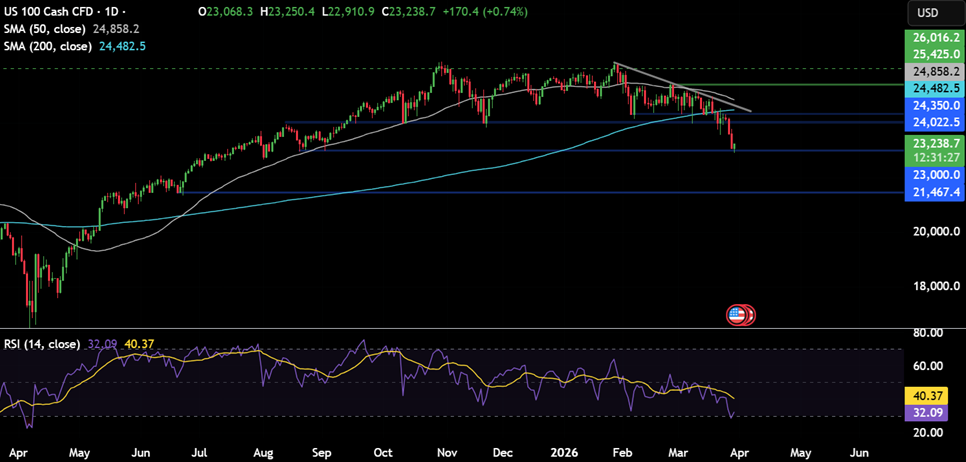
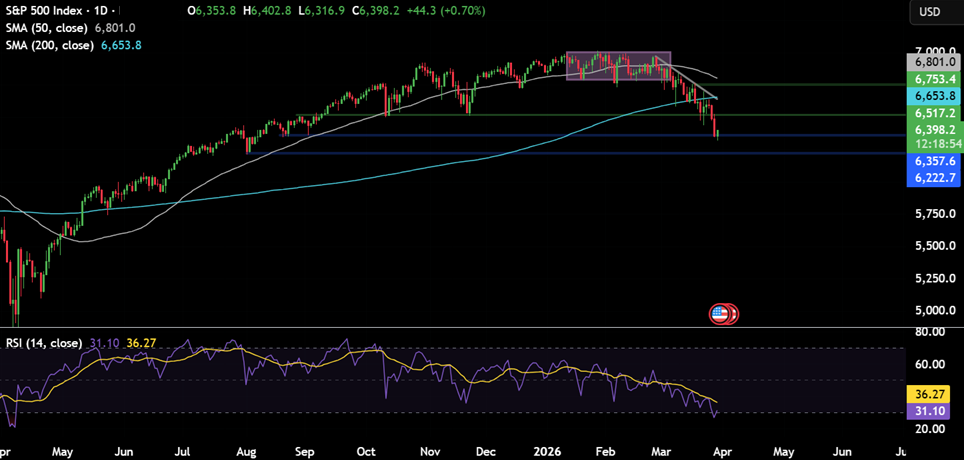
US stocks fell for a fifth straight week, weighed down by persistent geopolitical tensions and elevated oil prices, which have intensified stagflation concerns. The S&P 500 fell 2.1% last week, while the Nasdaq dropped 3.2% — its worst weekly performance since last April’s “Liberation Day” sell-off. The tech-heavy index has now closed more than 10% below its record high, putting it firmly in correction territory.
Major US data/themes
Last week was a light week for economic data, with geopolitical tensions the central focus, with headlines driving market moves. Headlines will likely remain the primary focus this coming week, although the US economic calendar ramps up again and could begin to show the impact of the war and higher oil prices on the US economy.
Gold moves
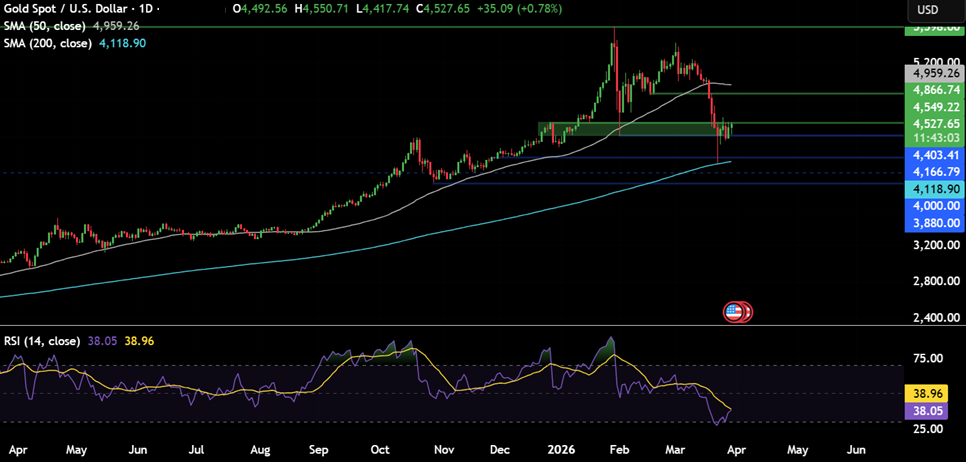
Gold rebounded last week, recovering from a sharp sell-off to close modestly higher after three straight weeks of losses totalling more than 15%. However, the broader backdrop remains challenging. Markets have shifted from pricing in rate cuts to considering the risk of further tightening, supporting the US dollar and pushing Treasury yields higher — both key headwinds for Gold.
If the dollar remains firm, US Treasury yields continue to rise, and the upcoming US nonfarm payroll report comes in strong, gold could remain vulnerable to further downside pressure.
Oil moves
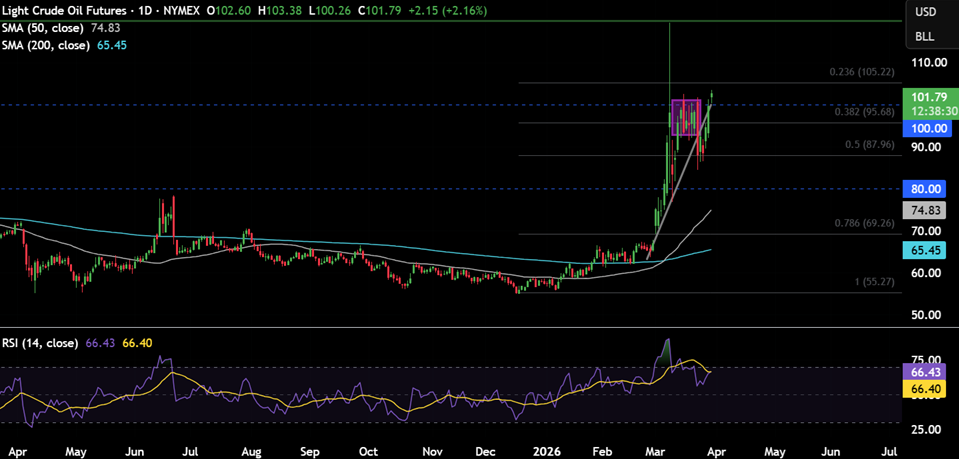
Brent fell 1% last week, after 5 weeks of gains, while the WTI rose 1.3%, following modest losses of 0.4% the previous week. Both oil benchmarks are rising at the start of the week and trade almost 50% higher this month. Last week, investors had to navigate conflicting reports about whether the US and Iran were moving toward de-escalation.
However, the US is reportedly sending 10,000 additional troops to the region, along with another aircraft carrier, raising fears of further escalation rather than de-escalation. The Strait of Hormuz remains largely closed to vessels linked to the US and Israel, with only a handful of ships now passing through each day compared with roughly 200 per day before the conflict.
Attention is also likely to turn increasingly towards Bab el-Mandeb, another key energy chokepoint off the coast of Yemen. As the Iran-backed Houthis become more involved in the conflict, any disruption there or to the Suez Canal could add further pressure to global oil markets.
Indian markets
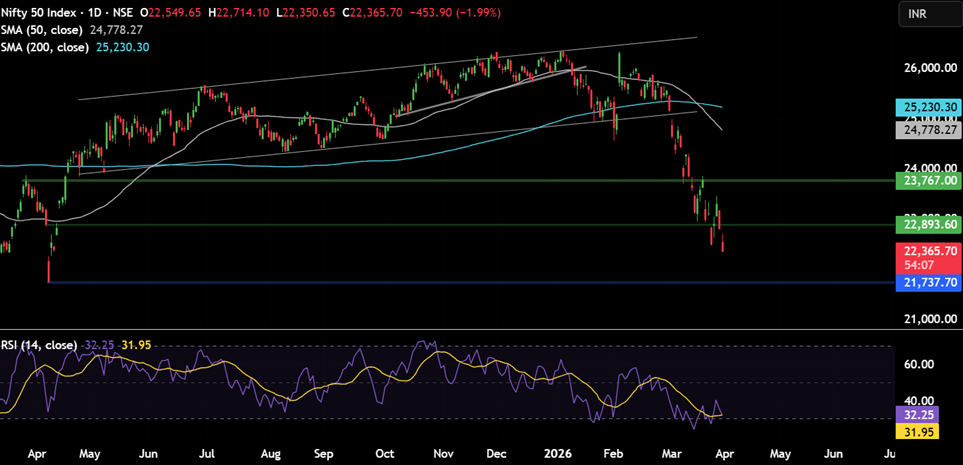
Indian stock markets extended their losing streak to a fifth consecutive week, marking their longest run of weekly losses since August 2025. Persistent selling pressure was evident throughout the week, while rising crude oil prices and broader macroeconomic headwinds continued to weigh on sentiment.
The Nifty 50 and the Sensex failed to sustain any recovery, ending the week 1.2% lower. As India is a major importer of crude oil, higher prices widen the current account deficit and fuel inflation concerns, putting additional pressure on both equity and currency markets. Sustained outflows from foreign institutional investors have further aggravated the situation.
In March, Foreign institutional investors (FIIs) increased sales of Indian equities, offloading stocks worth Rs. 1.1 lakh crore
Meanwhile, domestic institutional investors (DIIs) continue to provide strong support to the market, largely absorbing the selling pressure and purchasing Rs 1.28 billion during the month.
India’s private sector business activity faltered in March due to shockwaves from the Iran war and rising oil prices. The private sector grew at the slowest pace in over three years, highlighting risks to India’s growth. The composite PMI fell to 56.5 in March from 59 in February.
Key Indian market drivers: Markets will remain highly sensitive to headlines from the Middle East, particularly any implications for oil prices and inflation expectations. At the same time, US nonfarm payrolls and ISM/PMI data will be critical in assessing whether higher energy costs are beginning to weigh on economic activity, shaping expectations for the Fed outlook. In India, manufacturing and industrial production data is due.
USD/INR rose for a sixth straight week last week and is rising further at the start of the new week to 95.55. This marks a fresh record low for the Rupee as the Indian currency continues to face significant pressure from consistent foreign outflows from the Indian stock market and higher oil prices.
Pakistan markets
The Pakistan Stock Exchange extended its losing streak to a ninth consecutive week as ongoing geopolitical tensions and the absence of meaningful positive economic catalysts continued to weigh on investor sentiment.
With no sign of de-escalation, global markets remained under pressure, with oil prices elevated. Against this backdrop, the KSE-100 fell 0.68% week-on-week amid concerns that inflationary pressures linked to the conflict could begin filtering through to the broader economy.
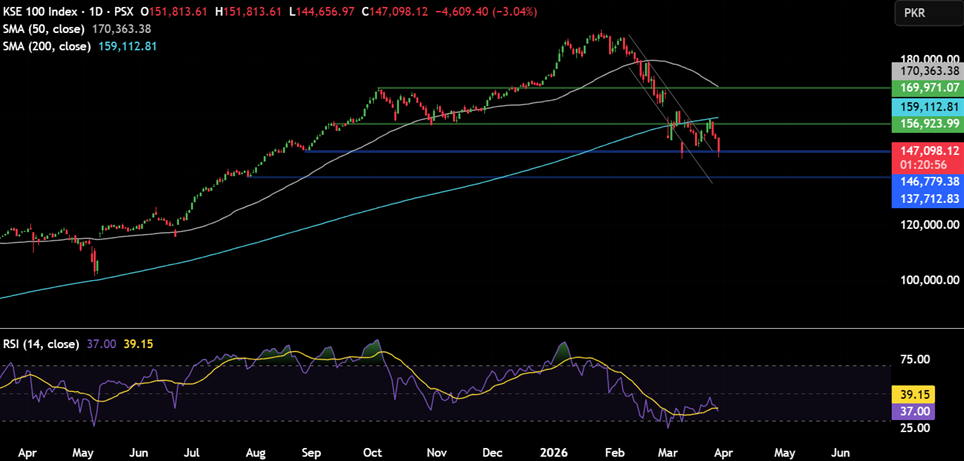
The Pakistani rupee remained broadly stable against the US dollar, appreciating marginally by 0.02% over the week to 279.15. The price holds at this level at the start o the new week.
Looking ahead, market direction is likely to remain closely tied to geopolitical developments, March inflation data, and the upcoming monetary policy decision. Progress on IMF negotiations marks an important step towards a staff-level agreement. The IMF has reached a staff-level agreement with Pakistan, unlocking $1.2 billion of loans from a $7 billion bailout programme. This could offer some support to sentiment.
Week ahead (US & Asia)
Chinese PMIs (Tuesday)
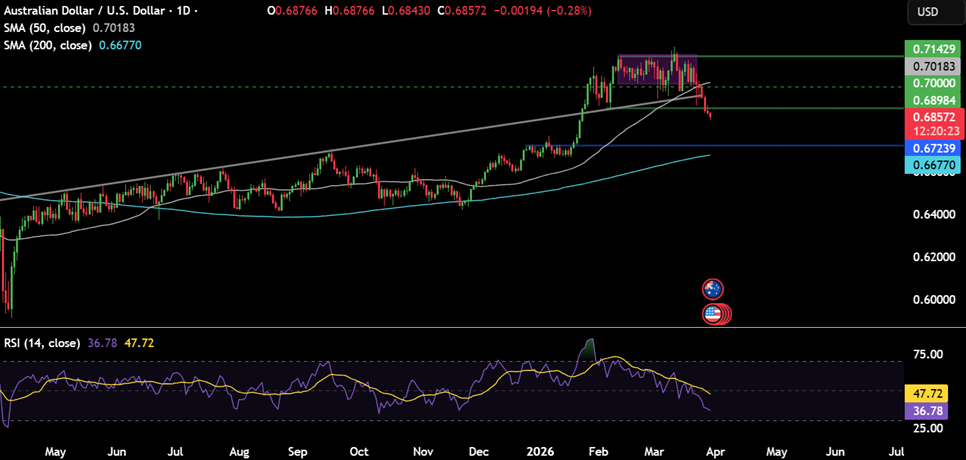
China’s official NBS manufacturing and non-manufacturing PMIs, due on Tuesday, will offer an early read on whether activity is stabilising in the world’s second-largest economy. Markets expect manufacturing PMI to improve to around 50 from 49 in February, potentially returning to expansion territory after spending much of the past year below the key 50 threshold. A move back above 50 would be an encouraging sign, particularly after Lunar New Year distortions.
That said, investors will also be watching whether the official data continues to diverge from the more export-focused Caixin surveys. New orders, export demand, and pricing components will be key, especially as rising energy costs begin to affect Asian supply chains too.
The non-manufacturing PMI is expected to rise modestly to 49.9 from 49.5. This remains in contraction. Weaker data than expected could put pressure on the Aussie (AUD/USD)– often considered a proxy for China.
US retail sales (Wednesday)
The health of the US consumer remains another important theme. Bank of America’s consumer checkpoint data for February showed spending growth accelerating to 3.2% year-on-year — the strongest pace in three years. That suggests consumer demand has remained relatively resilient, helped in part by larger tax refunds and still-healthy household finances.
However, with labour market concerns building and energy costs rising, markets will want to know whether consumers can keep spending at the same pace. If consumer demand begins to soften at the same time inflation is picking up, that would further reinforce the stagflation narrative that has been building across markets and could weigh on stocks such as the S&P 500.
US ISM manufacturing & services PMIs (Wednesday & Friday)
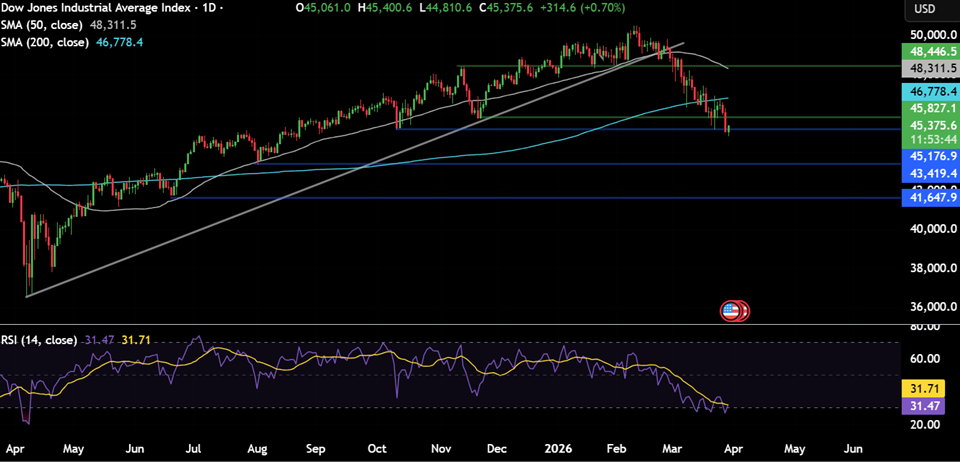
US ISM data will be watched closely for early signs of how the energy shock is affecting the economy. These surveys are among the timeliest indicators of business activity and will be important in helping markets judge whether rising oil prices are beginning to slow growth while also pushing inflation higher.
Expectations are for ISM Manufacturing PMI to ease very slightly to 52.3 from 52.4. The prices paid component will be particularly important. It had already risen to 70.5 in February — its highest level since mid-2022 — even before oil prices surged.
The services PMI, due on Friday, will also matter. The S&P Global services reading fell to 51.1 in March from 51.7, marking an 11-month low, as firms cited softer demand and weaker confidence.
Again, the key detail here will be price pressures. If both manufacturing and services are showing rising input costs alongside weaker activity, that would reinforce stagflation concerns and could weigh on stocks, pulling the Dow Jones lower.
Pakistan CPI (Thursday)
Data is expected to show that inflation in Pakistan rose 0.9% MoM in March, up from 0.3% in February. On an annual basis, inflation is expected to rise to 7.9%, up from 7% and wholesale inflation is also expected to pick up to 2% from 1.1%. The data will provide first indications of how higher oil prices are feeding into the broader economy. Hot inflation could raise expectations for rate hikes and weigh on stocks.
Nonfarm payrolls (Friday)
Friday’s US jobs report will be one of the biggest events of the week. February’s nonfarm payrolls report surprised to the downside, with the economy losing 92,000 jobs after January’s figure was revised lower. Meanwhile, the unemployment rate rose to 4.4%, moving closer to November’s four-year high of 4.5%. That report revived concerns about the health of the US labour market.
This month’s report will therefore be watched closely to see whether February was a one-off soft patch or the beginning of a more sustained slowdown. That matters because the Fed is now dealing with a difficult backdrop: rising inflation expectations linked to energy prices, but also signs that growth may be cooling. Consensus currently points to a modest rebound in jobs growth to 42,000, with unemployment expected to remain at 4.4%.
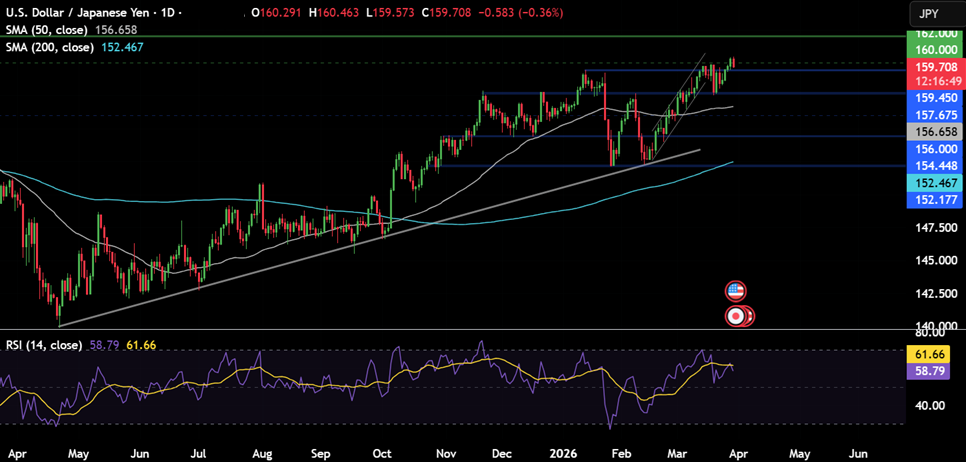
If payrolls disappoint again, markets could start to price in a greater chance of Fed easing later in the year, which would likely weigh on the US dollar and USD crosses such as the USD/JPY and support rate-sensitive assets. A stronger report could support more hawkish Fed bets, boosting USD.
Trading involves risk.
Author


 Risk Disclaimer
The content provided here is for informational purposes only. It is not intended as personal investment advice and does not constitute a solicitation or invitation to engage in any financial transactions, investments, or related activities. Past performance is not a reliable indicator of future results.
The financial products offered by the Company are complex and come with a high risk of losing money rapidly due to leverage. These products may not be suitable for all investors. Before engaging, you should consider whether you understand how these leveraged products work and whether you can afford the high risk of losing your money.
The Company does not accept clients from the Restricted Jurisdictions as indicated in our website/ T&C. Some services or products may not be available in your jurisdiction.
The applicable legal entity and its respective products and services depend on the client’s country of residence and the entity with which the client has established a contractual relationship during registration.