12 min read
Recent weeks recap:
US global stocks recap
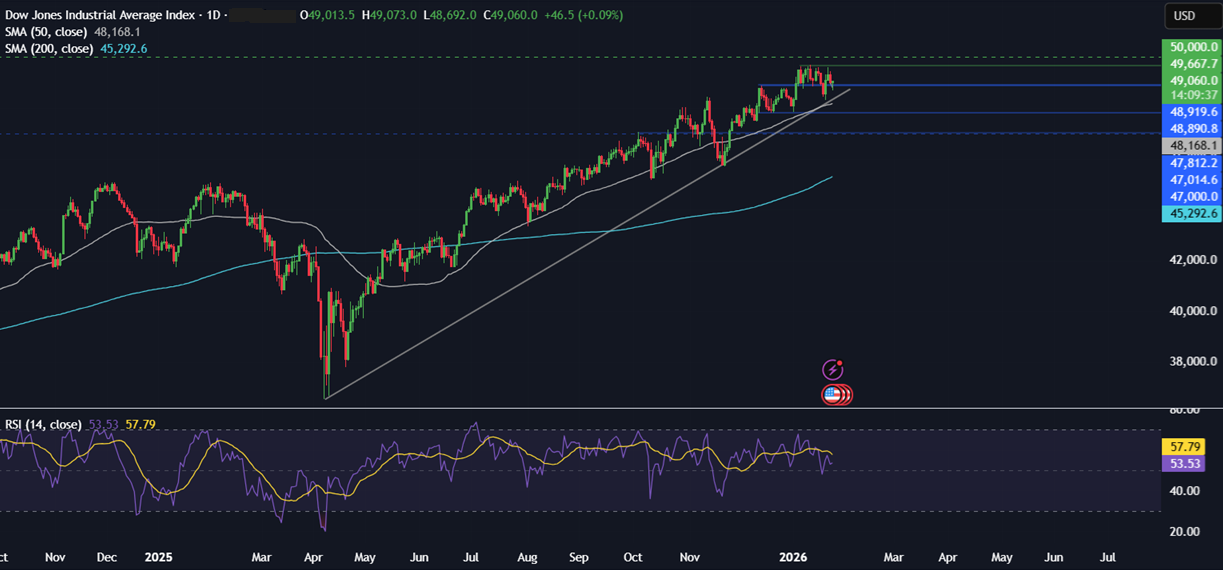
After steep declines at the start of the week, US stocks reversed course mid-week, rebounding on Wednesday and Thursday before running out of steam on Friday. As a result, the S&P500 ended the week 0.35%, and the Dow ended the week 0.55% lower.
Major US data/themes
The week was dominated by Trump and his threats of trade tariffs over his desire to acquire Greenland. Following a speech in Davos, Trump announced a framework for a deal over Greenland, withdrawing trade tariff threats and fueling a recovery in risk sentiment.
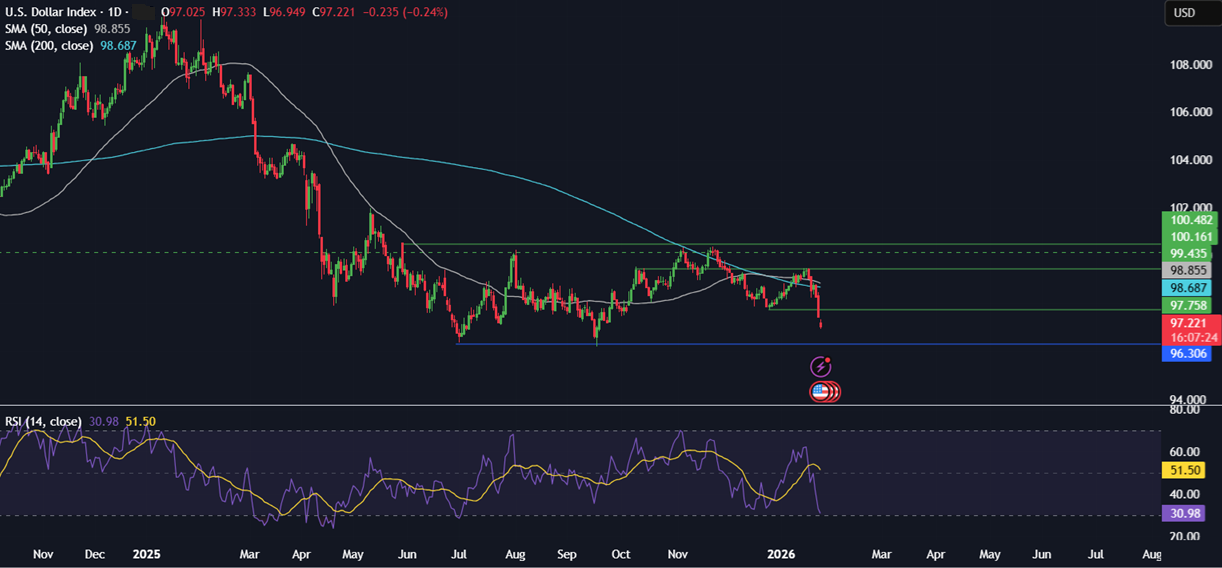
However, it’s worth noting that the US dollar fell 1.8% across the week, and Gold and Silver continued to push to fresh record highs even on Friday after the deal was announced. This underscores a lingering nervousness among the markets, potentially linked to US policy instability and a lack of credibility surrounding the trump administration. The USD is falling further at the start of the new week.
On the data front, US Q3 GDP was upwardly revised to 4.4% annualised, while US core PCE, the Fed’s preferred gauge of inflation, held steady at 2.8%. This data gives the Fed no reason to rush to cut interest rates.
Gold / Silver moves
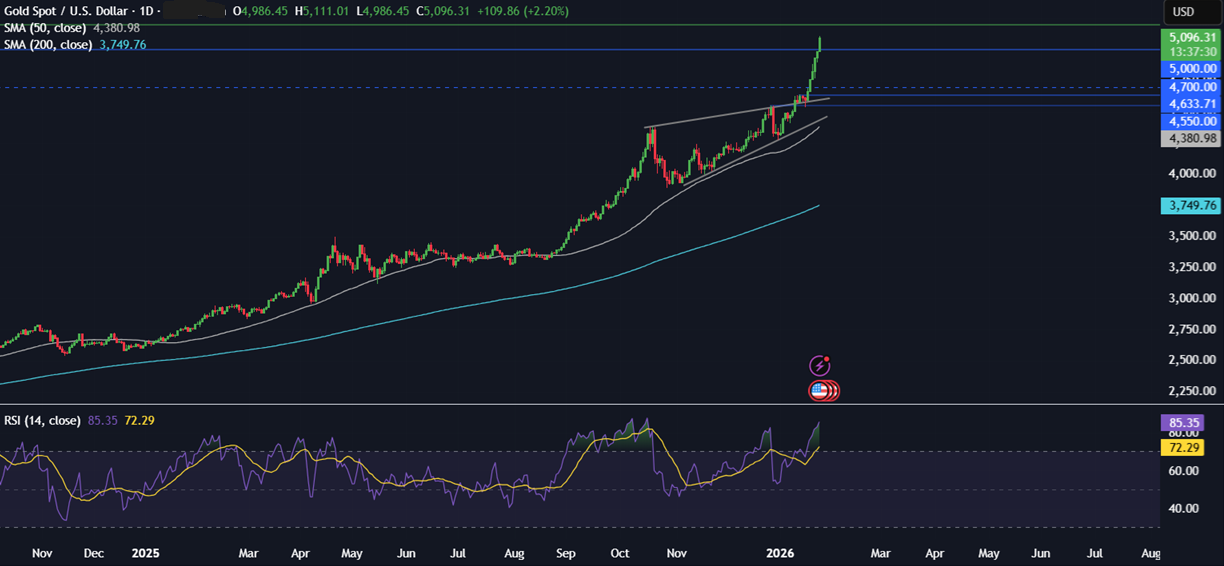
Gold and Silver both charged higher last week, extending gains and hitting fresh record highs and are pushing higher still at the start of the new week. Gold has soared past $5,000 to $5,100, and Silver is nearing $110. The gains follow an impressive start to the year, with Gold trading 18% higher and silver up 53%. US–EU tensions, uncertainty over US policy, concerns about the Federal Reserve’s independence and a weaker USD have all contributed to the surge in precious metals. These metals are increasingly being seen as a hedge against Trump.
Looking ahead, geopolitics could remain in focus, but this time with attention on Iran. Escalating tensions could keep Gold supported as could concerns over yen intervention. The FOMC meeting could also influence the metals. A cautious-sounding Fed could see Gold and prices pull back from these key psychological levels.
Oil moves
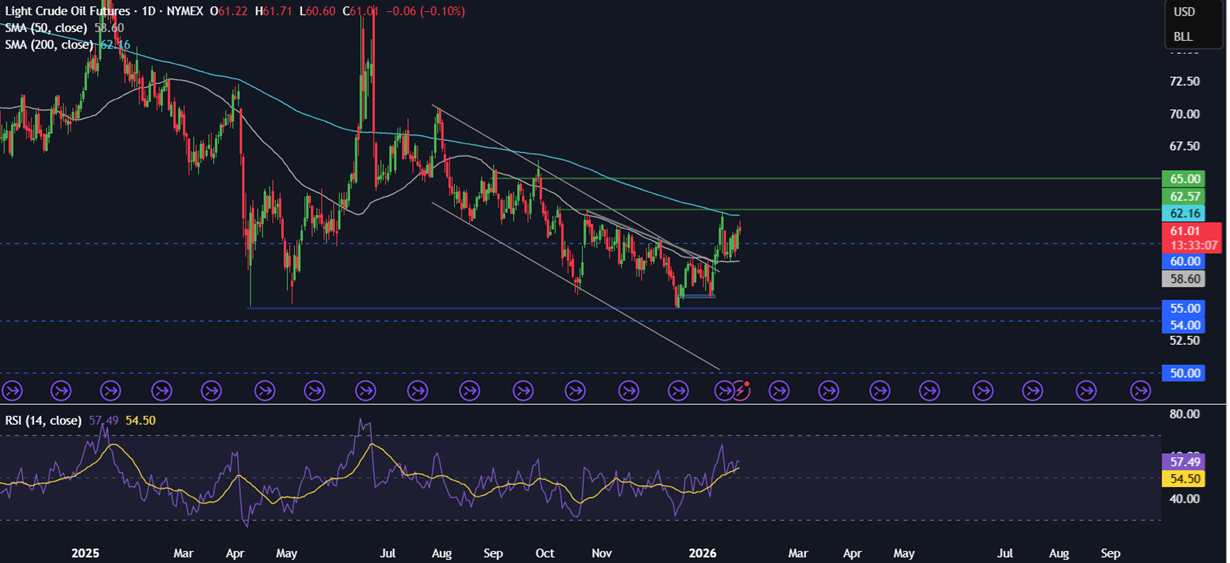
Oil prices rose 2.7% last week, marking the fifth straight weekly gain. Oil prices were lifted by revived threats of US military intervention in Iran, OPEC’s fourth-largest oil producer, as well as an Arctic cold blast, which drove natural gas prices 46% higher last week, helping WTI prices rise above 60.00. This week, prices will likely remain sensitive to headlines as Trump sends an “armada” towards the Middle East.
Investors will also be watching developments surrounding Russia and Ukraine, with the two sides and the US set to resume peace talks this week after two days of “constructive” peace talks, even as the war showed no signs of easing. Any sense that the two sides are moving towards a peace agreement could pull oil prices lower.
Indian markets
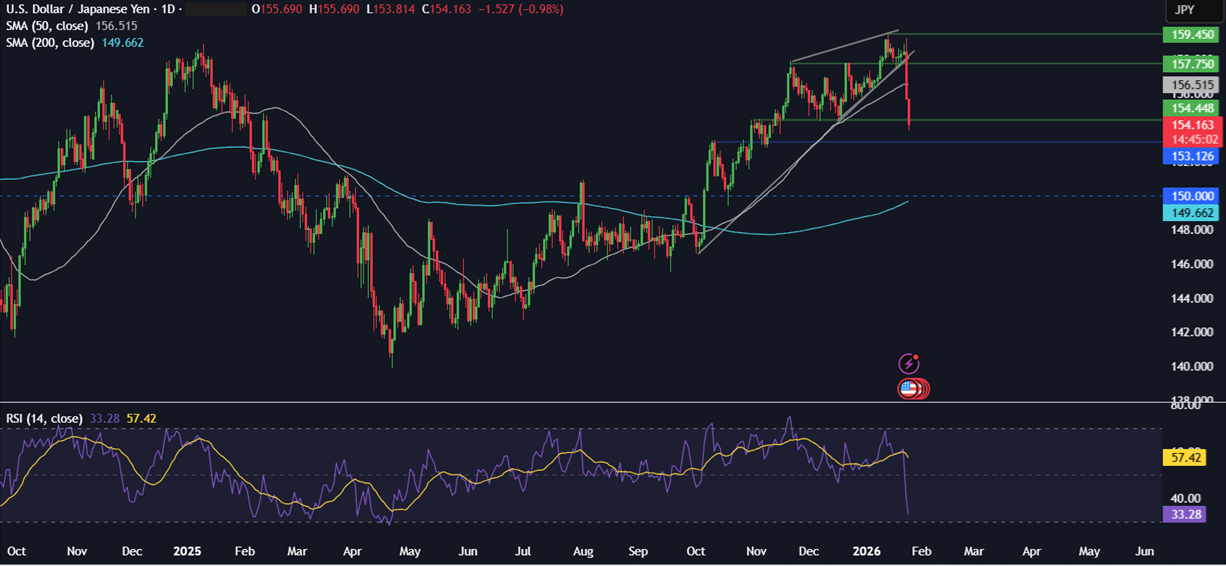
Indian markets ended the week lower, with the Nifty 50 and the Sensex shedding 2.5% and 2.4%, respectively, amid bearish market sentiment, marking the steepest weekly decline in four months. The mood deteriorated amid renewed global trade tensions, continued foreign investor outflows and as the Rupee fell to fresh record lows against the USD.
Foreign Institutional Investors (FIIs) saw continued selling last week, with FIIs remaining net sellers in 14 of 15 trading days and have sold shares worth Rs 36,591.01 crore so far in January. FIIs continue to sell Indian stocks amid the absence of a US-India trade deal and poor Q3 earnings.
Meanwhile, domestic investors remained net buyers, supporting the markets by purchasing shares worth R20.743 crore.
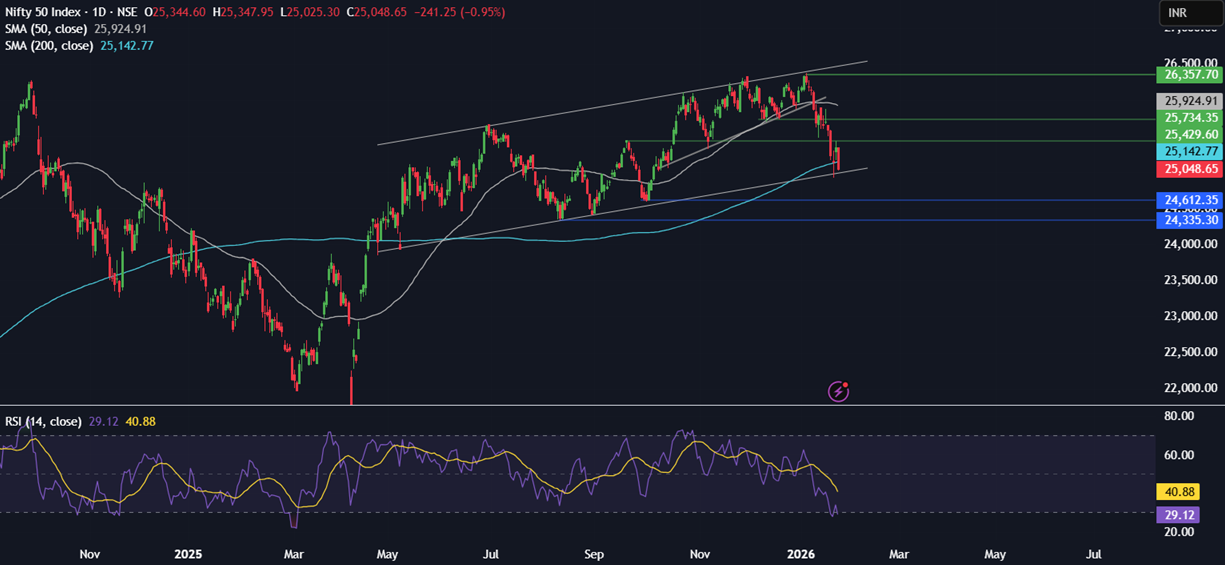
On the data front, India’s PMI for January came in stronger than expected. The composite PMI, a good gauge of business activity, rose sharply to 59.5 from 57.8 in December, driven by strong output in both the manufacturing and service sectors. Manufacturing PMI came in at 56.8, higher than the previous reading of 55. The services PMI expanded to 59.3 from 58 in December.
Key Indian market drivers this week include the ongoing Q3 earnings season and manufacturing and industrial production figures. Investors will also be looking to position ahead of the Union Budget on February 1. Meanwhile, geopolitical headlines could continue to influence sentiment ahead of the FOMC rate decision. US tech earnings will also be under the spotlight. Monday is a public holiday in India.
USD/INR rose 1.06% last week, marking the fifth straight weekly rise, taking the Rupee to a record low against the USD of almost 92.00. The slump comes amid ongoing withdrawals of foreign funds from the Indian stock market and despite a significant decline in the USD.
Pakistan markets
The Pakistan Stock Exchange (PSX) scaled to a fresh record high above 189,000 as investors appeared to be positioning for a further cut in interest rates. On the macroeconomic data front, the sensitive price index (SPI) for the week ending January 22 rose 4.18% year on year whilst declining 0.48% week on week, signalling easing short-term inflationary pressures.
Looking out across this week’s ongoing corporate earnings season could remain supportive, while the main focus will be on today’s rate decision as the market remains optimistic of another rate cut. Geopolitical headlines could also influence sentiment.
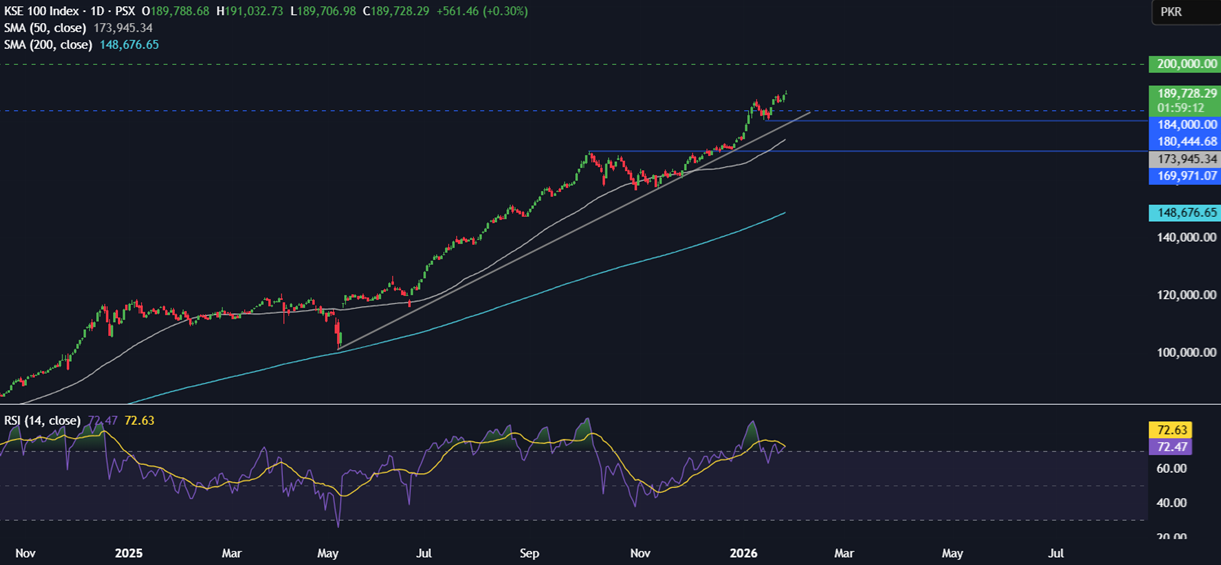
USD/PKR dropped 0.84% last week, settling on Friday at 277.64 amid a weaker USD.
Week ahead (US & Asia)
State Bank of Pakistan rate decision (Monday)
The State Bank of Pakistan is due to meet today and is expected to cut interest rates by a further 50 basis points amid easing inflation, improved external stability, and a build-up in foreign exchange reserves. Expectations for further easing were reinforced by the latest auction of government treasury bills, where three- and six-month tenors fell to single-digit levels for the first time in four years.
Businesses have been calling for a faster reduction in borrowing costs, arguing that lower interest rates are necessary to support industrial activity and the broader economy. The State Bank of Pakistan surprised markets by cutting rates by 50 basis points to 10.5% at the 15 December meeting, as inflation remained within the target range of 5 to 7%.
Tech earnings
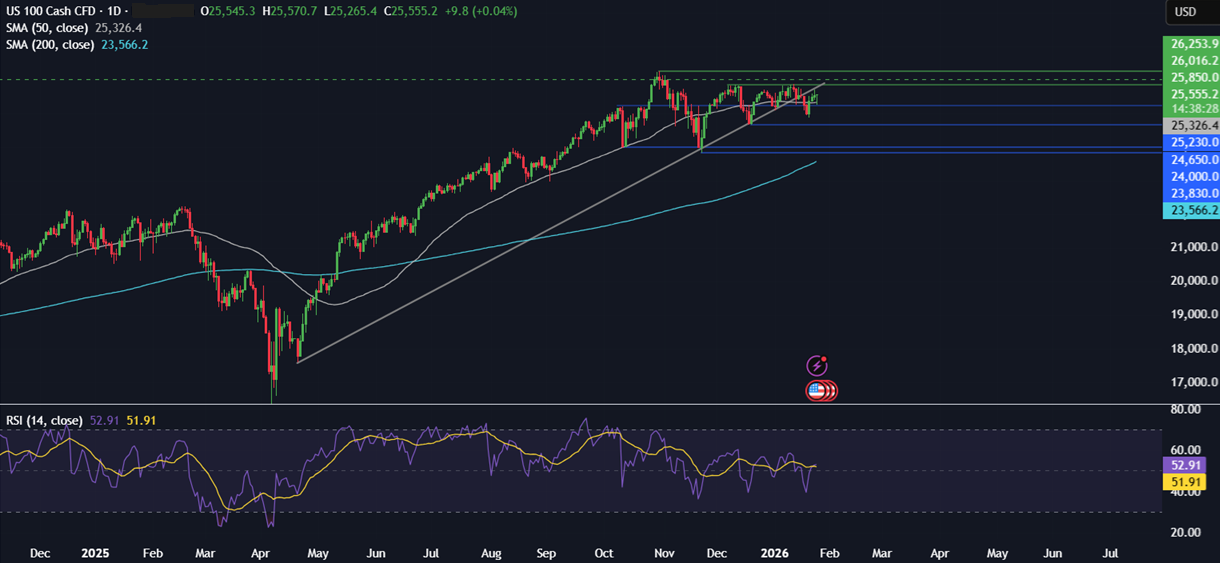
This is the second busiest week of Q4 earnings season, with 103 S&P 500 companies scheduled to report this week. Four of the “Magnificent 7” are set to report quarterly earnings this coming week, including Microsoft, Tesla, Meta, and Apple, which could set the tone for the entire sector. Attention will be on AI capex, which, for hyperscalers, is expected to top $600 billion in 2026. The earnings come after a recent rotation out of tech stocks since October into value stocks through large-cap cyclicals and small caps.
These moves came as the market grew sceptical of the hundreds of billions being spent to develop AI and on when those investments would yield returns. The group is expected to post 20% profit growth in Q4, the slowest pace since 2023. Therefore, these firms are under pressure to show that the vast sums committed to capital expenditures are starting to pay off. Strong earnings could help capital flow back into the tech sector and lift the Nasdaq. Weak earnings could fuel the rotations away from tech.
Australian CPI (Wednesday)
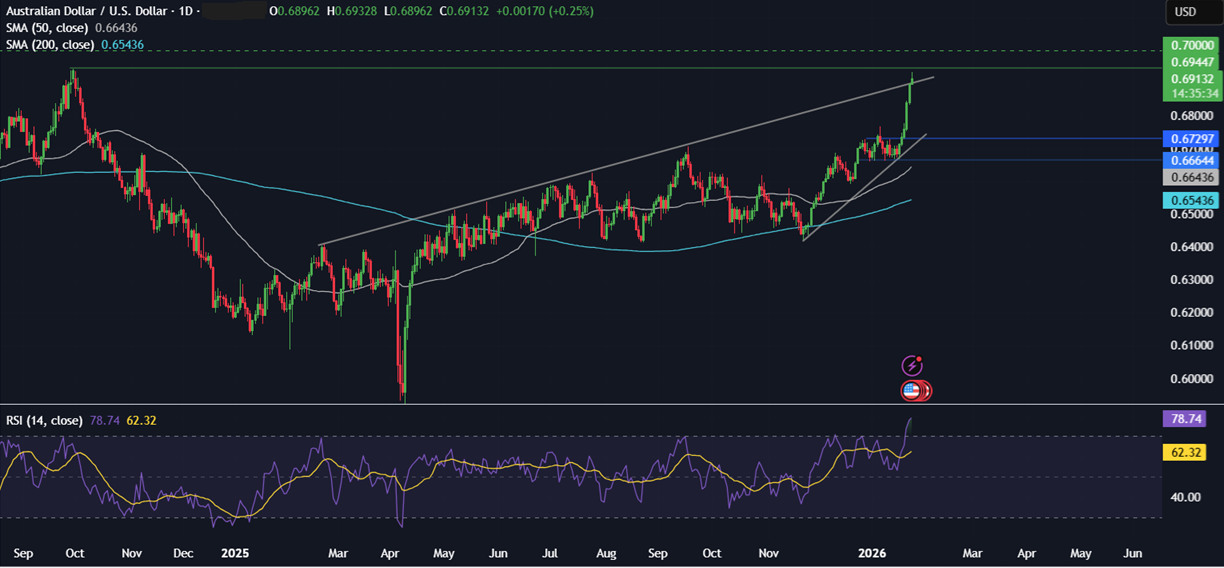
Q4 and December CPI are due on Wednesday. Q3 CPI rose 1.3%, up from 0.7% in Q2, taking the annual headline CPI rate to 3.2%, up from 2.1% in Q2 and marking the highest quarterly increase since March 2023. This was mainly driven by housing costs and the service sector, particularly travel prices. Since the Q3 CPI release, inflation has shown elevated pressures peaking at 3.8% in October before easing to 3.4% in November. The December 2025 CPI level is expected to show headline inflation rose 0.5%, taking the annual rate to 3.5%.
A hotter-than-expected CPI could reinforce the RBA’s tightening bias. The market is pricing in a 60% probability of a 25-basis-point hike at the February meeting, with a full 25-basis-point hike priced in by May. The Aussie dollar has been a notable strong performer, and hot inflation data could send AUD/USD higher.
FOMC rate decision (Wednesday)
The Fed will hold its first policy meeting of the year this week, announcing its decision on Wednesday, and no change in rates is expected. The Fed cut interest rates by 25 basis points to 3.5% to 3.75% in the December meeting on a nine-to-three vote. Federal Reserve chair Jerome Powell said the Fed is well-positioned to wait and see how the economy evolves, emphasising a data-dependent approach. Since the meeting, U.S. data has been stronger than expected, with GDP growth upwardly revised to 4.4% annualised.
Meanwhile, core inflation is it 2.8%, giving the Fed little reason to move on rates for now. There are also signs that the labour market has stabilised, although current “no hire no fire” conditions are hardly screaming of a recovery. The market is pricing in a 95% chance of no change, and right now the focus will be on Powell’s press conference for hints on labour and inflation risks, amid tariff and geopolitical uncertainties. A cautious Fed could offer some support to the USD, which is falling sharply.
Fed chair nominee
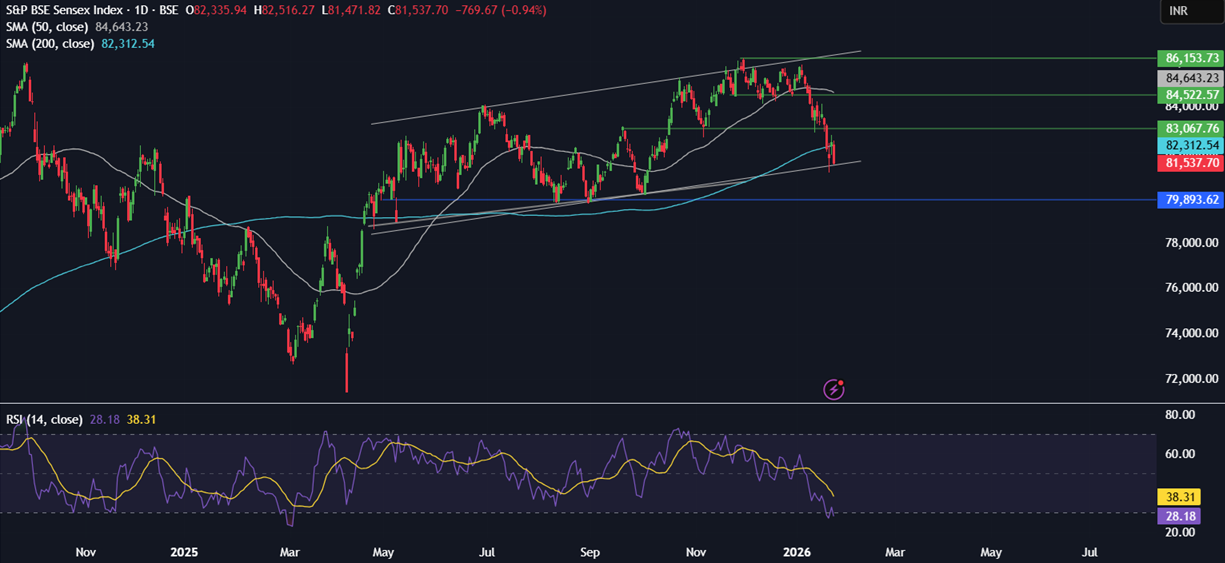
It is, of course, possible that the largest highlight this week may not come from the Fed or from data. President Trump might try to steal Powell’s thunder by finally announcing who will replace the Fed chair in May. It’s thought that Trump has narrowed the selection to 4 candidates, including White House economic adviser Kevin Hassett, Fed governor Christopher Waller, former Fed governor Kevin Wash, and Rick Rieder, BlackRock’s chief bond investment manager.
While US equities could be happy with any of those picks, bond markets may prefer Christopher Waller. The US dollar, on the other hand, may not see an immediate reaction, preferring to wait for more clarity on policy direction under the new leadership.
Tokyo CPI (Friday)
Tokyo CPI data comes after the BoJ meeting last week, when the central bank left rates unchanged at 0.75% but lifted its inflation and growth guidance, keeping the prospect of more rate hikes on the table. Core CPI for December eased to 2.3% YoY, amid some cooling in price pressures owing to lower energy prices and easing food inflation. Cooler-than-expected Tokyo inflation could lower expectations of further BoJ rate hikes.
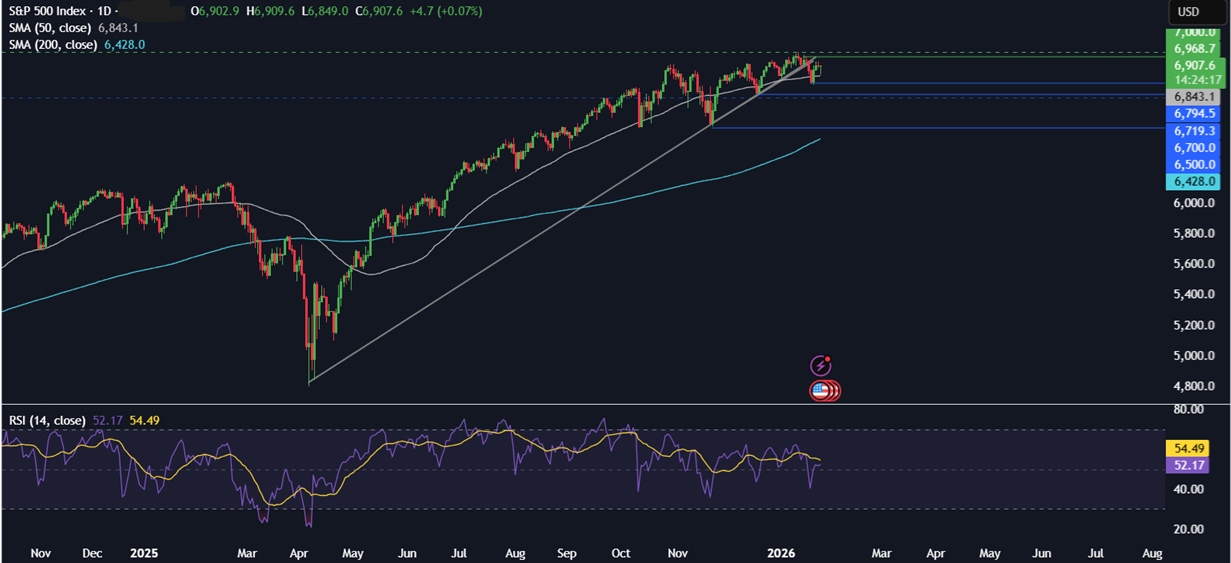
However, it’s also worth keeping an eye on Japanese bond yields, which have been extremely volatile following the dissolution of parliament and the snap election called for February 8th. USD/JPY fell sharply on Friday, dropping 200 points on a “rate check”. Reports of further intervention are also swirling.
Union Budget (Sunday)
The Indian Union Budget will be unveiled on Sunday, February 1, by Finance Minister Nirmala Sitharaman at a time when economic and geopolitical headwinds are increasing. All eyes will be on how the Modi government aims to protect the Indian economy, particularly the export sectors, from Trump’s 50% tariffs. Corporate India will be hoping for clarity on taxes, reforms, and policy priorities that can unlock the next leg of economic growth.
There is expected to be a continued focus on capital expenditure (capex) to boost infrastructure and support long-term growth, even amid fiscal constraints. This could be central to the agenda. Meanwhile, there are strong calls for tax cuts or middle-class relief to spur consumption. Improved sentiment after the budget could boost Indian stock indices, such as the Sensex.
Trading involves risk.
Author


 Risk Disclaimer
The content provided here is for informational purposes only. It is not intended as personal investment advice and does not constitute a solicitation or invitation to engage in any financial transactions, investments, or related activities. Past performance is not a reliable indicator of future results.
The financial products offered by the Company are complex and come with a high risk of losing money rapidly due to leverage. These products may not be suitable for all investors. Before engaging, you should consider whether you understand how these leveraged products work and whether you can afford the high risk of losing your money.
The Company does not accept clients from the Restricted Jurisdictions as indicated in our website/ T&C. Some services or products may not be available in your jurisdiction.
The applicable legal entity and its respective products and services depend on the client’s country of residence and the entity with which the client has established a contractual relationship during registration.